
Neo-Traditional Tattoo Style Guide: Bold Lines, Rich Color
A complete guide to neo-traditional tattoo style — what separates it from American traditional and new school, its defining features, popular subjects, and how to design one with AI.

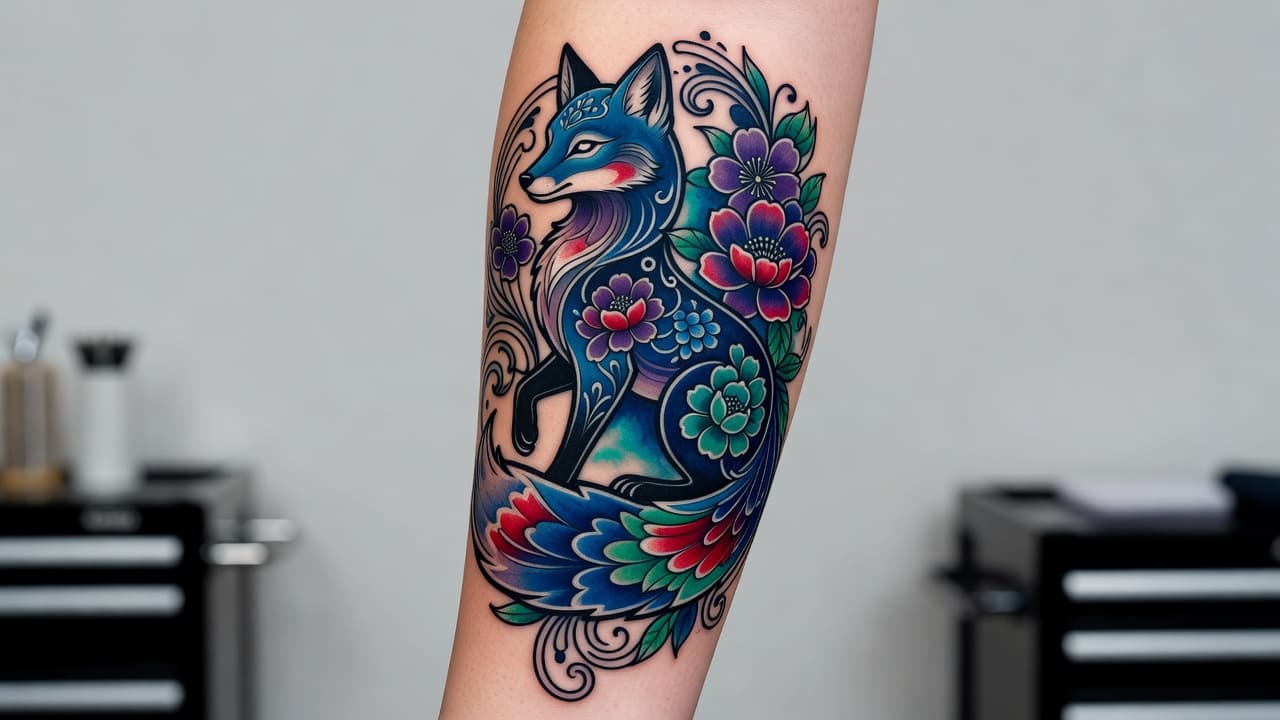
A neo-traditional tattoo takes the bold outlines and solid color of old-school Americana and pushes them further — deeper shading, richer palettes, and far more freedom in subject matter, from ornate animal portraits to Art Nouveau-inspired florals. If you love the punch of traditional tattooing but want more detail and dimension, neo-traditional is usually the style you're picturing.
In short: neo-traditional tattooing is a modern evolution of American traditional that keeps traditional's bold black outlines and saturated color but adds painterly shading, an expanded palette, and more elaborate, illustrative subject matter. This guide breaks down exactly what sets it apart from both classic traditional and new school tattooing, the features that define it, and how to design a neo-traditional piece before you ever sit in an artist's chair.
What Is Neo-Traditional Tattoo Style?
Neo-traditional emerged in the 1990s and 2000s as tattoo artists trained in American traditional tattooing began pushing past its limitations. Traditional tattooing developed its bold, simple rules — thick outlines, flat color, minimal shading — largely out of necessity: early tattoo ink and equipment couldn't reliably hold fine detail over decades on skin. As tattooing techniques and inks improved, artists started asking how much more detail, color, and dimension they could add while keeping the durability that made traditional tattoos age so well.
The answer was neo-traditional: keep the bold, confident black outline as the structural backbone of the piece, but layer in realistic shading, gradient color blending, and more sophisticated composition. Many neo-traditional artists cite Art Nouveau illustrators like Alphonse Mucha as a visual reference point — decorative borders, flowing lines, and elegant female figures surrounded by ornamental flourishes are recurring motifs in the style.
What makes neo-traditional distinct from most other modern tattoo styles is that it never abandoned the underlying discipline of traditional tattooing. Fine-line and single-needle styles trade the bold outline away entirely in favor of detail, which is part of why they demand more touch-ups over time. Neo-traditional keeps the bold line as a non-negotiable structural element and adds detail inside it instead — a middle path that gives collectors more visual richness without giving up traditional's long-term durability advantage.
Neo-Traditional vs. Traditional (American Traditional) Tattoos
The easiest way to understand neo-traditional is side by side with the style it evolved from:
| Feature | American Traditional | Neo-Traditional |
|---|---|---|
| Outlines | Thick, uniform weight | Bold, but weight varies for depth |
| Color | Small, flat, solid palette | Expanded palette with blended gradients |
| Shading | Minimal to none | Realistic, painterly shading throughout |
| Subjects | Simple, iconic (anchors, swallows, roses) | More elaborate, illustrative, ornamental |
| Composition | Standalone, symmetrical | Dynamic, often framed with decorative elements |
Both styles share the same durability advantage: bold outlines and solid color blocks hold their shape under skin far better than fine, unshaded linework. Neo-traditional simply adds more visual information inside that reliable structural frame.
Neo-Traditional vs. New School: What's the Difference?
People frequently mix up neo-traditional and new school, and it's an easy mistake — both moved beyond classic traditional in the same era. The difference comes down to tone and proportion:
- New school — Cartoonish, exaggerated proportions, graffiti and animation influence, bright almost-neon color, playful and high-energy subjects.
- Neo-traditional — Illustrative and painterly, closer to poster art and Art Nouveau, moodier and more sophisticated color grading, elegant rather than exaggerated forms.
If a design looks like it could be a comic-book panel, it's leaning new school. If it looks like it could be a vintage illustrated poster, it's neo-traditional.
Defining Features of Neo-Traditional Tattoos
A handful of technical choices separate neo-traditional from every style around it:
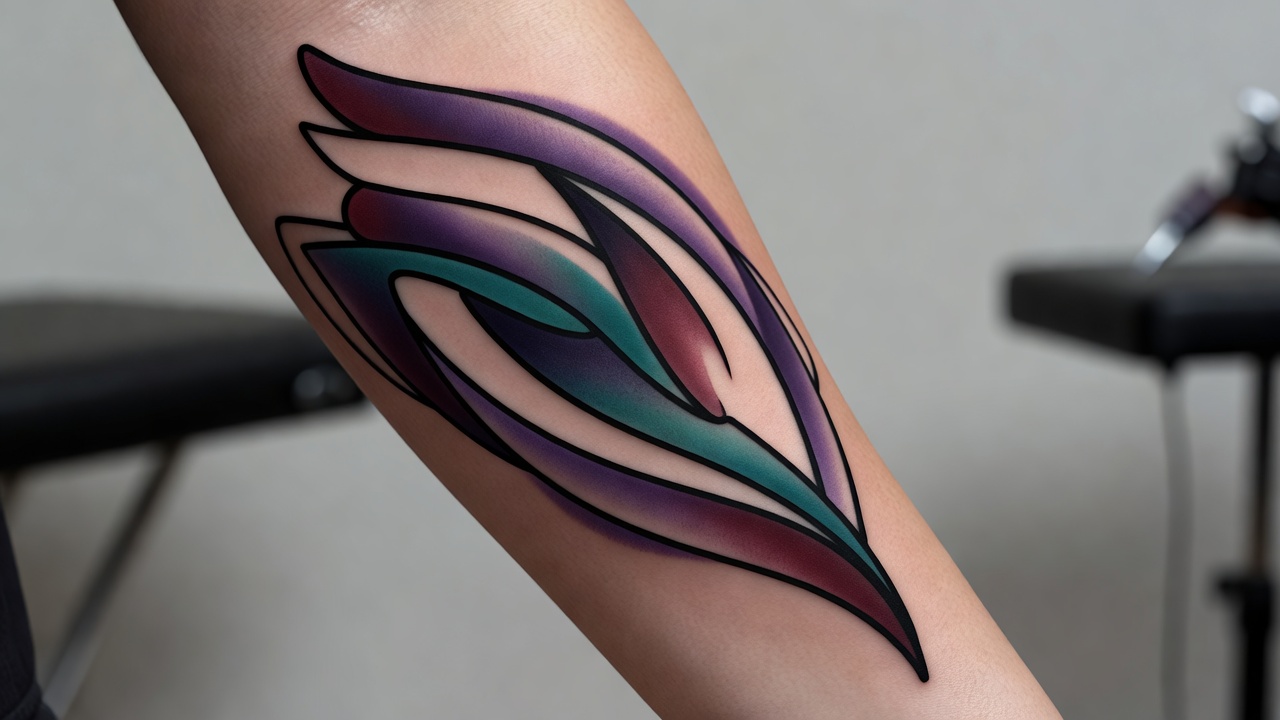
- Variable-weight bold outlines — Still thick and confident, but the line weight shifts to suggest form and depth rather than staying perfectly uniform.
- Layered, painterly shading — Soft gradients built up inside the outline, giving the piece a sense of light and volume that flat traditional color doesn't have.
- Expanded, jewel-toned palette — Deep purples, teals, and burgundies alongside traditional reds, greens, and yellows.
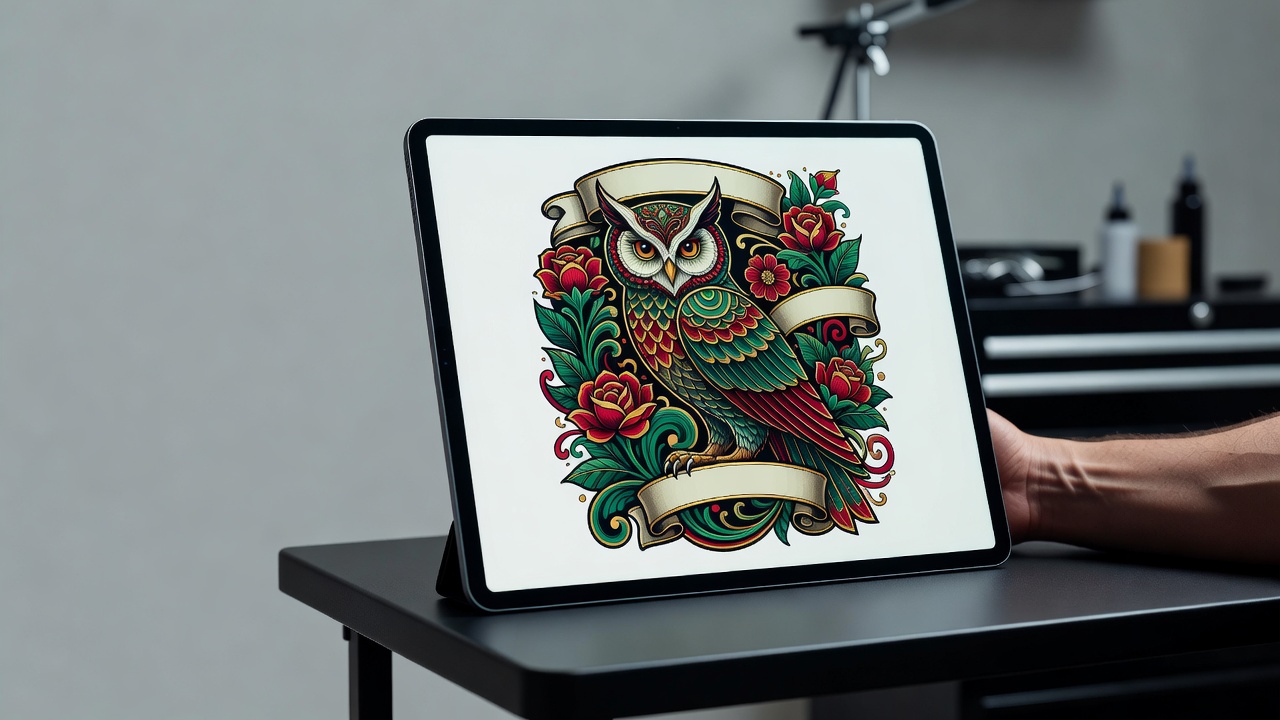
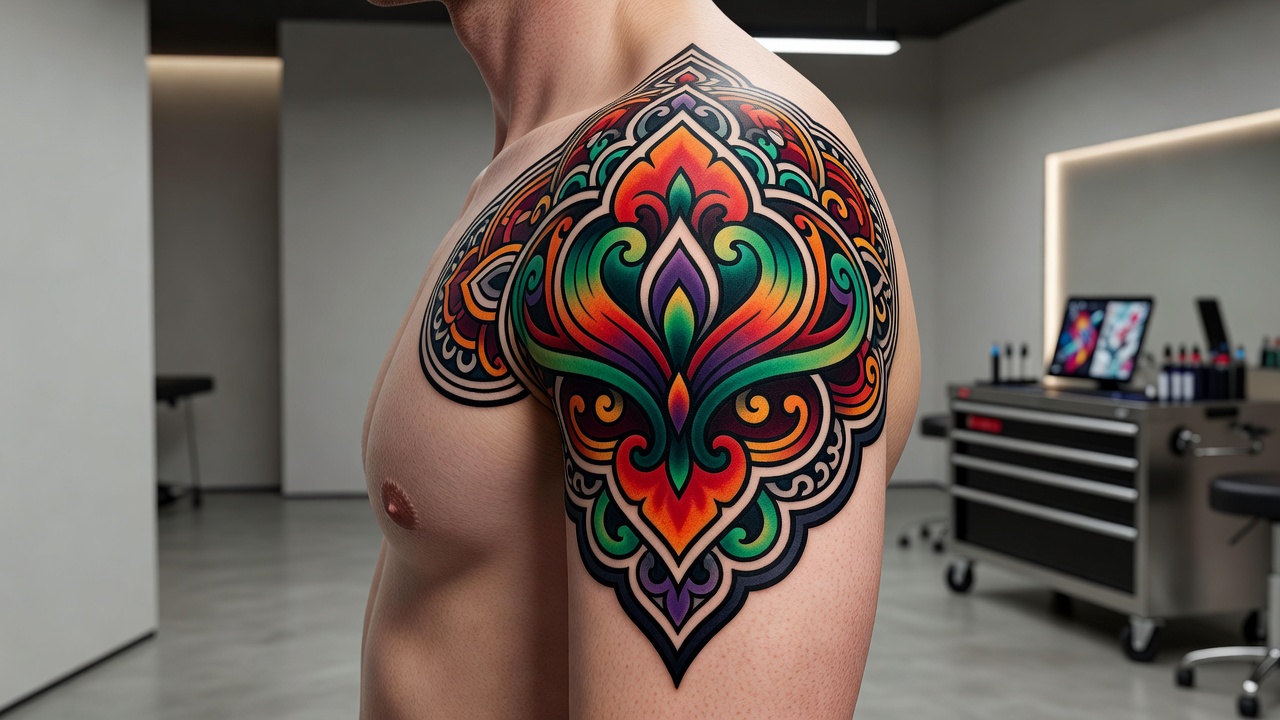
- Ornamental framing — Banners, filigree, gems, and decorative borders that wrap the central subject.
- Illustrative, storybook quality — Compositions often feel like a single frame pulled from a larger illustrated scene.
Popular Neo-Traditional Tattoo Subjects
Neo-traditional artists tend to gravitate toward subjects that reward extra detail and ornamentation:
- Animals with personality — Foxes, owls, wolves, and ravens rendered with expressive eyes and layered fur or feather shading.
- Botanical and floral pieces — Roses, peonies, and full florals with gradient petals and ornamental leaf work, expanding on the simpler flowers common in classic traditional tattooing.
- Mythological and folklore figures — Deities, spirits, and legendary creatures given a decorative, poster-art treatment.
- Skulls and memento mori — Skulls framed with flowers, banners, or jewels rather than left plain, often carrying symbolic weight; see our guide to meaningful tattoo symbols for more on this theme.
- Portraits with ornamental framing — Especially pin-up or Art Nouveau-style female figures surrounded by decorative elements.
Best Placements for Neo-Traditional Tattoos
Because neo-traditional pieces carry more visual information than classic traditional, they generally need a bit more room:
- Upper arm and shoulder — Enough space for ornamental framing without crowding the central subject.
- Forearm — Highly visible, flat surface that shows off gradient shading well.
- Thigh — Large, sun-protected canvas ideal for a bigger, more detailed composition.
- Back and chest — Best for large-scale, multi-element neo-traditional scenes.
Smaller neo-traditional pieces work too, but simplify the ornamental detail so it doesn't blur together at a reduced scale. Our full tattoo placement guide covers pain levels and visibility trade-offs for every spot on the body.
How Much Do Neo-Traditional Tattoos Cost?
Neo-traditional pieces typically cost more than equivalent-sized classic traditional tattoos because of the extra time spent on shading, color blending, and ornamental detail. A small single-subject piece (3-5 inches) generally runs a few hundred dollars, while a larger composition with framing and multiple color transitions — a shoulder piece or a full sleeve panel — can take several sessions and run well into four figures. Most artists price neo-traditional by the hour rather than a flat rate once the design goes beyond a simple, standalone subject, since shading time varies a lot piece to piece. Our tattoo pricing guide breaks down hourly rates and what drives cost up in more detail.
Finding the Right Neo-Traditional Artist
Neo-traditional rewards artists with strong traditional fundamentals — the bold outline and color-holding instincts of classic tattooing — layered with genuine illustration skill. When reviewing portfolios, look for:
- Confident, consistent outline weight that doesn't waver or thin out
- Smooth color transitions without muddy or grey-looking blends
- Healed photos, not just fresh work — shading is what tends to soften over time
- A portfolio that shows the artist's own compositional style rather than copied reference work
It's also worth asking how an artist approaches touch-ups. Because neo-traditional relies on gradient shading rather than flat color, a small percentage of pieces need a single touch-up session within the first year or two as the skin settles and heals fully — this is normal and not a sign of a bad tattoo. A good artist will tell you this upfront rather than let you find out on your own.
Designing Neo-Traditional Tattoos with AI
Because neo-traditional combines a specific outline style with detailed shading and color, it helps to see a composition rendered before you commit. An AI tattoo generator makes this easy: describe your subject along with "neo-traditional," the color palette you're picturing, and any ornamental elements like banners or florals, and INK will generate design options in seconds.
- Test different color palettes — jewel tones vs. classic traditional reds and greens — on the same composition
- Compare outline weight and shading density across variations
- Preview the finished design on your body with AR before booking an appointment
- Export a clean reference image to bring to your artist
For the full step-by-step workflow, see our guide to using an AI tattoo generator. Neo-traditional is also one of the styles trending upward this year — see our 2026 tattoo trends roundup for where it fits among what's popular right now.
Neo-Traditional Tattoo FAQ
What is neo-traditional tattoo style? A modern evolution of American traditional that keeps its bold outlines and saturated color while adding realistic shading and more elaborate subject matter.
How is it different from traditional tattoos? Traditional uses uniform outlines, flat color, and simple subjects; neo-traditional varies line weight, blends gradient color, and favors ornamental, illustrative compositions.
Is it the same as new school? No — new school is cartoonish and neon-bright; neo-traditional is painterly and closer to Art Nouveau poster art.
Does it age well? Yes, generally very well, because it keeps traditional's bold, durable outline as its structural foundation.
Neo-traditional endures because it keeps what always worked about traditional tattooing — bold, durable structure — while giving artists and collectors far more room to tell a detailed, personal story in the design. Take the time to find an artist whose portfolio shows both strong fundamentals and genuine illustrative range.
Design Your Neo-Traditional Piece
Test color palettes, outline weight, and ornamental framing before you book. Free in INK.
Generate Neo-Traditional Designs Free →

Create Your Perfect Tattoo Design
Use AI to generate unique tattoo designs and preview them on your body before committing to ink.
Start Designing for FreeWritten by

Laura Schmitz
Tattoo Content Lead, INK
Laura Schmitz leads tattoo content at INK. She has spent years researching tattoo styles, symbolism and aftercare, and works directly with the AI tattoo generator to test how each style translates from prompt to skin — so every guide here reflects designs that are actually tattooable, not just images that look good on screen.
More about the author