
Evil Eye Tattoo Meaning: Symbolism, Colors & Placement
What an evil eye tattoo really means — protection from envy and ill will, drawn from a symbol thousands of years old — plus what color, style, and pairing with a hamsa change about it, and the best places to wear one.
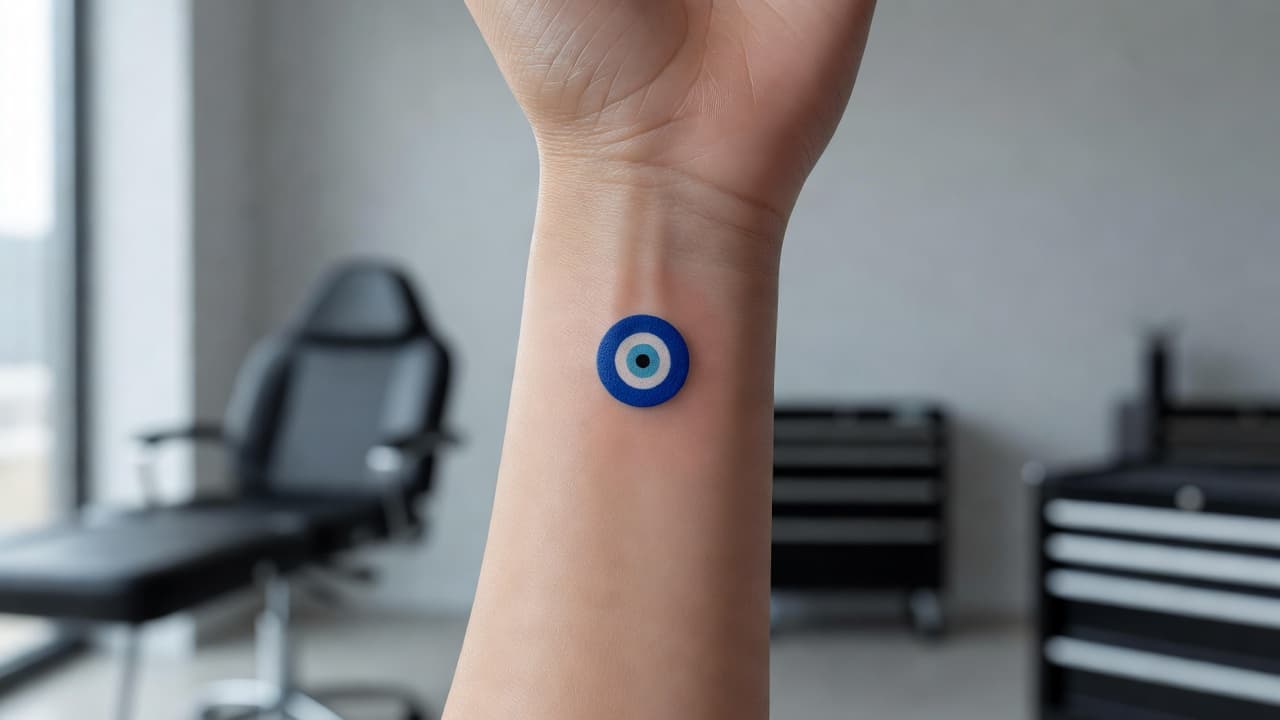
The evil eye tattoo meaning comes from one of the oldest and most widespread folk beliefs in the world: that an envious or ill-wishing glance can bring real misfortune to whoever it lands on. The eye-shaped amulet — known as the nazar in Turkish and Arabic — exists specifically to counter that glance, which is why an evil eye tattoo represents protection, not harm. It is worn to watch back and deflect negative energy, not to wish it on anyone.
If you're considering an evil eye for your next piece, this guide covers what the symbol actually represents, where it comes from, how color and pairing with a hamsa shift the meaning, and the styles and placements that let a small, symmetrical design do its best work.
What Does an Evil Eye Tattoo Mean? (Quick Answer)
An evil eye tattoo means protection from envy, ill will, and negative energy. It is a stylized eye, almost always rendered in concentric rings of blue, based on an amulet — the nazar — that people across the Mediterranean, Middle East, and South Asia have worn for thousands of years to guard against the "evil eye": the folk belief that a malicious or jealous stare can cause real harm. Getting the symbol tattooed is protective by design, not an invitation of bad luck.
Where Does the Evil Eye Symbol Come From?
The belief in a harmful gaze is ancient and remarkably widespread — versions of it appear in Greek, Roman, Jewish, Islamic, Hindu, and Buddhist tradition, among many others, which is part of why the symbol feels universal rather than tied to one closed culture. The earliest known eye-shaped amulets date back thousands of years, and by around 1,500 BCE artisans in Anatolia were producing the glass-bead version most people picture today — the nazar, from the Arabic and Turkish word for sight or gaze.
The nazar's design isn't arbitrary. It's built from concentric rings — usually dark blue, light blue, white, and a black center — meant to visually mirror an eye staring back. The logic is almost defensive: the amulet doesn't hide from the harmful gaze, it confronts and reflects it. That same logic carries directly into the tattoo — an evil eye inked on the skin functions the same way a nazar bead hung by a doorway does, as a permanent, personal ward rather than decoration alone.

Evil Eye vs. Hamsa Tattoo: What's the Difference?
The two symbols are often shown together, which leads to some confusion. A hamsa is a hand-shaped amulet — the name comes from the Arabic word for "five," referring to the five fingers — associated across different traditions with blessing, strength, and protection. Many hamsa designs include an eye set into the center of the palm, which is where the two symbols visually merge. An evil eye tattoo on its own is just the eye, with no hand.
Getting them combined isn't wrong — a hamsa with an eye in its palm is one of the most common protective tattoo designs precisely because it layers two forms of warding-off-harm symbolism into one image. But each also stands completely on its own, so there's no requirement to include a hand if the eye alone is the meaning you want. If you're drawn to protective and meaningful symbols more broadly, our meaningful tattoo symbols guide covers several others worth comparing.
What Do Different Evil Eye Tattoo Colors Mean?
Color carries more weight in an evil eye design than in most tattoos, because the traditional cobalt blue isn't a stylistic choice — it's part of the original folklore.
- Deep blue. The most traditional and historically accurate choice. Blue eyes were considered rare and unusually powerful in the Mediterranean cultures where the amulet originated, which is why blue became the protective color rather than any other.
- Black-and-grey. Strips the color association away entirely and puts the focus on the linework and the concentric ring pattern itself, which reads clearly even without color.
- Red or green. Not part of the original tradition, but chosen by some for a more personal, decorative meaning — often paired with other colored elements in a larger piece rather than standing alone.
- Multi-eye clusters. Several small eyes scattered together (sometimes in different colors) are a popular modern take that keeps the protective symbolism while reading as a more playful, decorative composition.

Popular Evil Eye Tattoo Styles
Because the symbol is simple and symmetrical, it adapts easily across very different tattoo styles:
- Minimalist single-line. A small, single-color eye rendered in fine line work — the most popular approach for a first tattoo or a subtle, everyday piece.
- Mandala-framed. The eye set inside a detailed mandala pattern turns a small symbol into a larger, more decorative centerpiece. Our mandala tattoo meaning guide covers that pairing in more depth.
- Floral-framed. Flowers surrounding the eye soften the design and are a common choice for anyone who wants the protective meaning without a stark, graphic look.
- Hamsa combination. The eye set into a hamsa hand, as covered above, layering two protective symbols into one piece.
- Realistic glass-bead style. Some artists render the eye to look like an actual glass nazar bead, complete with shading and highlights, rather than a flat graphic version.

Is an Evil Eye Tattoo Cultural Appropriation?
This comes up often, and the honest answer is nuanced. The evil eye belief and its eye-shaped countermeasure appear across Greek, Turkish, Middle Eastern, North African, South Asian, and Latin American folk traditions, which makes it one of the most geographically widespread protective symbols in the world rather than the property of a single closed culture. That breadth is part of why so many different backgrounds wear it without controversy.
That said, the symbol carries genuine spiritual and cultural weight for the communities where the belief is still actively practiced, so it's worth a little care: learn roughly where the specific version you're drawn to comes from, understand that it represents protection rather than a curse, and treat it with the same respect you'd want shown to a meaningful symbol from your own background. Approached that way, an evil eye tattoo is widely worn and rarely considered disrespectful.
Where Do Evil Eye Tattoos Look Best?
A single small eye is one of the most placement-flexible designs in tattooing, precisely because its symmetrical shape reads clearly even at a tiny scale. The wrist, behind the ear, the ankle, and individual fingers are especially popular spots, since the eye stays legible without needing much surrounding space. Larger pieces — an eye combined with a hamsa, florals, or a mandala — need more room to let the detail breathe, which makes the forearm, shoulder, or upper back better suited. For a broader look at how placement and pain interact across the body, see our tattoo placement guide and tattoo pain chart. If this style appeals to you specifically because it's small and simple, our small tattoo ideas guide covers other designs that work at the same scale.

Designing Your Evil Eye Tattoo with AI
Because so much of an evil eye design's impact rides on getting the proportions, ring pattern, and color balance right, it's worth seeing a few versions side by side before committing. In INK, you can describe your idea — a minimalist single eye, a mandala-framed version, or an eye paired with a hamsa — and generate several variations from a text description in seconds, then compare how the color and detail hold up at the size you're planning.
Once you land on a version you like, AR try-on lets you preview it directly on your wrist, hand, or wherever you're planning to place it, so you can confirm the scale and color read well on your own skin before booking a session with an artist. Our AI tattoo try-on guide walks through that process in more detail.
The Final Word
An evil eye tattoo endures because the idea behind it is simple and universal: something small, watchful, and permanent standing between you and other people's envy or ill will. Decide whether you want the traditional cobalt blue or a black-and-grey version, whether a hamsa or mandala frame fits the meaning you're after, and a placement that suits the scale you have in mind — then bring a clear reference to your artist.
Design Your Evil Eye Tattoo Free in INK
Describe your idea, pick a color and style, and preview the design on your body before you ink. No sign-up needed.
Try INK Free →

Create Your Perfect Tattoo Design
Use AI to generate unique tattoo designs and preview them on your body before committing to ink.
Start Designing for FreeWritten by
INK Team