
How Much Do AI Tattoo Generator Apps Cost? (2026 Pricing Guide)
What AI tattoo generator apps actually cost in 2026 — the free tiers, subscription bands, credit packs and watermark paywalls — plus INK's exact pricing and how to pick a plan without overpaying.

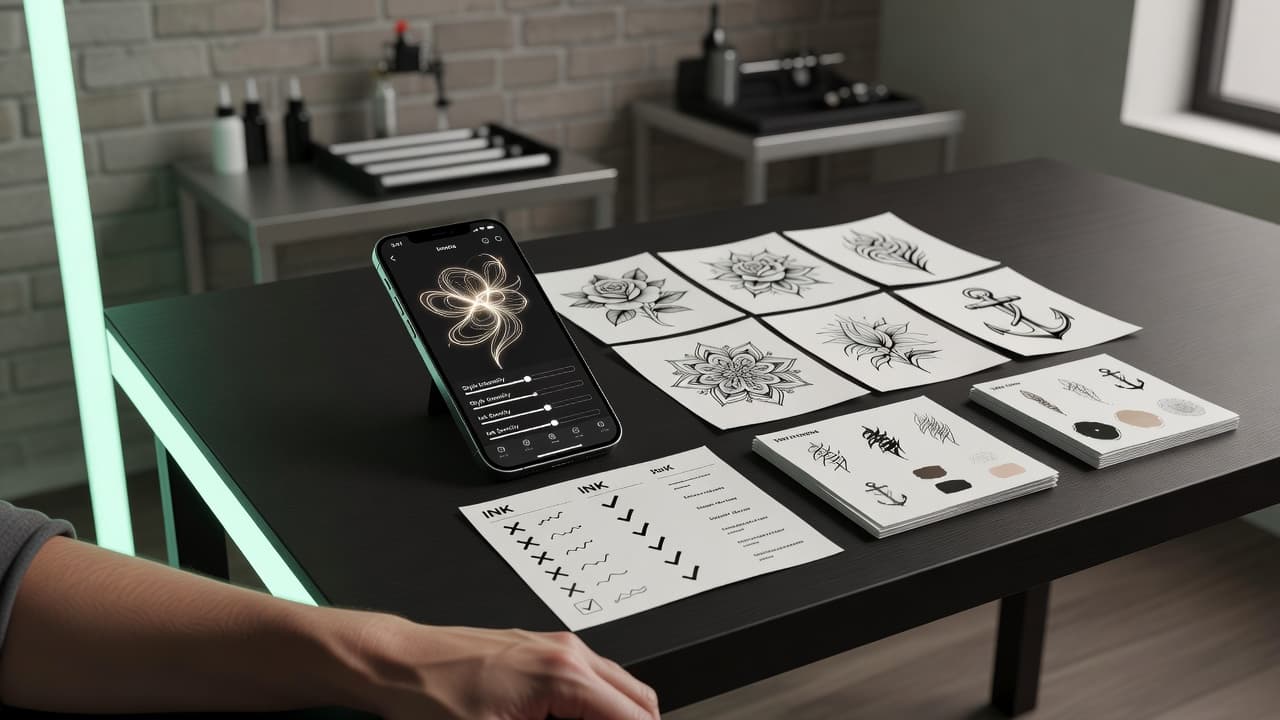
AI tattoo apps have gone from novelty to standard tooling in about two years, and the pricing has settled into a handful of recognisable patterns. If you are trying to work out what an AI tattoo generator costs before you commit, the useful answer is not a single number — it is understanding which of five pricing models you are looking at, and what each one actually charges you for.
In short: most AI tattoo generator apps land in a $5 to $15 per month band, annual plans commonly cut 50-80% off that monthly run rate, and a growing number offer a one-time lifetime purchase instead. Many also have a free tier with a daily generation limit. INK is free for 3 generations a day with no sign-up, and Pro is $14.99 per month, $39.99 per year, or $179 once for lifetime access on the web. Here is how those numbers break down, and how to avoid paying for something you were never going to use.
How Much Does an AI Tattoo Generator Cost?
Across the category, paid plans for AI tattoo apps typically sit somewhere between $5 and $15 per month. That is the observed band rather than a rule, and individual apps drift above and below it — a stripped-back single-feature tool can undercut it, while a full suite with on-body preview and editing tends to sit at the top of it or just above.
Annual plans are where the real discount lives. It is normal to see an annual price that works out to somewhere between a fifth and a half of twelve months at the monthly rate, which is why almost every paywall pushes you toward the yearly option. Lifetime purchases are less common but increasingly offered, usually priced at roughly three to five years of the annual plan.
One caveat worth stating plainly, because prices move: store pricing changes without notice and varies by country and currency. Treat any figure in an article — including the ranges here — as a starting point and confirm it on the live listing. The only numbers quoted as exact below are INK's own.
The Five Pricing Models You Will Run Into
Almost every AI tattoo app uses one of five models, or blends two of them. Recognising which one you are dealing with tells you far more about what you will actually spend than the number on the paywall does.
| Model | How It Works | What to Watch For |
|---|---|---|
| Permanent free tier | A fixed number of generations per day, every day, at no cost and usually with no card on file. | Check whether the daily allowance resets or is a one-off, and whether exports are watermarked. |
| Subscription | Recurring billing — weekly, monthly or annual — that lifts limits for as long as you keep paying. | Weekly plans look tiny and add up fastest. Annual plans are cheapest per month but lock you in. |
| Lifetime purchase | One payment, no renewal, permanent access to the paid feature set. | Only pays off if you use the app for years. Do the division before you buy. |
| Credit packs | You buy a batch of generations and spend them one design at a time. | Iteration burns credits fast, and some packs expire. Cost per usable design is the real metric. |
| Watermark-gated export | Generating is free or cheap; downloading a clean, high-resolution file is what you pay for. | Fine in principle — but only if you can judge the quality before the paywall appears. |
The two that catch people out are credit packs and watermark gating. Credits feel cheap because the up-front number is small, but tattoo design is inherently iterative — you rarely love the first render, and every retry costs one. A subscription that lets you generate freely often works out cheaper even at a higher sticker price. Watermark gating is fairer, provided the free output is good enough to judge before the paywall appears.
What INK Costs, Exactly
INK runs a permanent free tier plus an optional Pro plan, available on iOS, Android and the web app. The figures below are the web prices, billed directly. In the iOS and Android apps Pro is sold through the App Store and Google Play, which set their own prices per country and also offer a weekly plan — so the in-app paywall, not this table, is the authority on what you will pay on mobile.
| Plan | Price | What It Includes |
|---|---|---|
| Free | $0, permanently | 3 AI generations every day, all 40 tattoo styles, no credit card, no sign-up needed to start. Exports carry a small watermark. |
| Pro monthly | $14.99 / month (web) | No daily cap, no watermarks, high-resolution export, plus the Pro-only tools. |
| Pro annual | $39.99 / year (web) | The same Pro feature set, billed once a year. |
| Pro lifetime | $179 one-time (web) | Pro permanently, with nothing to renew and nothing to cancel. |
Two things follow from those web numbers. First, the annual plan is roughly a fifth of twelve monthly payments, so if you expect to use INK for more than about three months, monthly billing is the expensive way to do it. Second, lifetime at $179 is worth about four and a half years of the annual plan — sensible if you are the kind of person who plans several tattoos over time, hard to justify if you are designing one piece this month.
Subscriptions are billed through the App Store or Google Play on mobile, and through web billing on the web app. That has one practical consequence worth knowing: cancellation happens in your store account, not inside the app — Settings, then your Apple account, then Subscriptions on iOS, or the Google Play subscriptions screen on Android. No app developer can cancel a store subscription for you.
What You Actually Get for Free vs Paid
This is the section most pricing articles skip, and it is the one that decides whether you need to pay at all. In INK, three of the core generation tools are on the free tier — you can design a tattoo from scratch, convert a photo into a tattoo, and produce clean line art, all without spending anything.
| Feature | Free | Pro |
|---|---|---|
| Tattoo Design (text to design) | Yes | Yes, uncapped |
| Photo to Tattoo | Yes | Yes, uncapped |
| Sketcher (line art, flash, stencil-style) | Yes | Yes, uncapped |
| Community feed and My Designs history | Yes | Yes |
| Try It On (on-body preview) | Via the phone's native share sheet | Yes, in-app |
| Cover-Up Designer | No | Yes |
| Refine (iterative editing) | No | Yes |
| Daily generation cap | 3 per day | None |
| Watermark and export resolution | Small watermark, standard resolution | No watermark, high resolution |
The practical reading of that table: the free tier is genuinely enough to explore an idea and decide whether the app is any good. Three generations a day is a real constraint, but it resets daily, so a week of casual use gives you around twenty designs at no cost. What you pay for is speed and finality — unlimited iteration in one sitting, a clean file to hand to your artist, and the tools that edit rather than generate. Our guide to free AI tattoo generators goes deeper on what a free tier can realistically deliver.
Free Trials vs a Permanent Free Tier
These sound like the same thing and behave completely differently. A timed free trial gives you full access for three or seven days and then bills you automatically unless you cancel before the deadline. It is a legitimate model and disclosed at purchase, but it depends entirely on you remembering a date.
A permanent free tier works the other way round: there is no countdown, no card on file, and nothing that converts. INK does not run a timed free trial at all — the 3 generations a day are simply the free plan, indefinitely. That is a deliberate difference and worth stating plainly, because "free" in app store listings covers both models and they carry very different risks. If an app offers you a trial rather than a free tier, set a calendar reminder for the day before it ends. That single habit is the cheapest consumer protection available.
A free trial asks you to remember a date. A free tier does not ask you for anything. When you are comparing prices, that difference is worth more than a few dollars a month.
Putting the App Price in Context
An AI tattoo app is the cheapest line item in the process by a wide margin, and it helps to see the whole chain before deciding whether about $15 a month feels like a lot.
A custom tattoo design commissioned from an artist typically runs from roughly $50 to several hundred dollars, depending on complexity and the artist's standing — and that is for the drawing alone, before any ink. The tattoo itself commonly costs $50-$200 for a small piece, $200-$500 for a medium one, and $500 or considerably more for large work like a sleeve or back piece. Our full tattoo pricing guide breaks those figures down by size, style, artist rate and region.
Against that, a month of an AI tattoo app costs less than most studio minimums. The app does not replace the artist — a good one will always adapt your reference to your anatomy. What it does is get you to the consultation with a design you have already tested, sized and previewed on your own body, which makes an expensive appointment shorter and the result closer to what you pictured. That is why on-body preview is the feature most worth paying for.
How to Avoid Overpaying: Six Red Flags
Most of the money wasted on AI tattoo apps is not wasted on expensive plans — it is wasted on plans that quietly kept charging. These are the patterns worth screening for before you subscribe to anything.
- Auto-renewing weekly subscriptions. A weekly price looks trivially small next to a monthly one, but it renews fifty-two times a year while you forget about it, and annualised it is the most expensive way to run any subscription.
- Paywalled exports of designs you already made. Generating for free and then discovering you cannot download what you built is the least pleasant version of freemium. Acceptable when disclosed up front; not when it appears after the work.
- Credits that expire. Buying a pack of generations is fine. Buying one that evaporates in thirty days turns a purchase into a deadline — and the expiry is rarely printed on the paywall.
- A trial with no visible end date. If the app does not state when the trial converts and at what price, cancel first and decide later. Both stores show the conversion date in your subscription settings.
- No usable free output at all. An app that will not let you generate a single design before paying is asking you to buy quality sight unseen. There is enough competition that you never need to.
- Paying for features you will not use. Designing one tattoo needs generation and export — not a cover-up tool or an editing suite. See our roundup of the best AI tattoo generator apps for how feature sets differ.
Which Plan Should You Actually Pick?
There is a straightforward decision tree here, and it starts with how many tattoos you are planning rather than how much you want to spend.
If you are exploring an idea: stay free. Three generations a day for a week or two is enough to find a direction, test a few styles and decide whether AI design suits how you think. Nothing about the free tier expires, so there is no rush. If you are new to this, our walkthrough on using an AI tattoo generator will get more out of those three daily generations than a subscription would.
If you have booked an appointment: a single month of Pro is usually the right call. You get unlimited iteration in the week you actually need it, watermark-free HD files to hand your artist, and on-body preview to settle placement and scale. Then cancel through your store account. One month of Pro against a tattoo costing several hundred is not a close comparison.
If tattoos are an ongoing thing for you: the annual plan is the value option, and it stops being a monthly decision. Lifetime at $179 only makes sense past roughly the four-and-a-half-year mark, which is a real proposition for collectors and a bad one for everyone else. For a broader look at how the category stacks up on features as well as price, see our 2026 AI tattoo generator comparison.
One more thing that belongs in any pricing discussion: what you own afterwards. Designs you generate in INK belong to you, including getting them permanently tattooed — not something to take for granted across the category.
The Final Word
The honest summary of AI tattoo generator pricing in 2026: cheap relative to what it supports, confusing relative to how simple it should be. Expect $5-$15 a month, a heavy discount on annual, credit packs that cost more than they appear, and free tiers ranging from genuinely useful to purely decorative.
Whatever app you pick, the sequence is the same: use the free tier until it stops being enough, pay only for the stage where you actually need speed and a clean export, and cancel the moment the design is finished. A tattoo lasts decades. The subscription that helped you design it does not need to.
Start Free in INK — No Trial, No Card
3 AI tattoo generations every day, permanently. Explore 40 styles, design from text or a photo, and upgrade to Pro only when you are ready for unlimited designs and HD exports.
Try INK Free →

Create Your Perfect Tattoo Design
Use AI to generate unique tattoo designs and preview them on your body before committing to ink.
Start Designing for FreeWritten by

Laura Schmitz
Tattoo Content Lead, INK
Laura Schmitz leads tattoo content at INK. She has spent years researching tattoo styles, symbolism and aftercare, and works directly with the AI tattoo generator to test how each style translates from prompt to skin — so every guide here reflects designs that are actually tattooable, not just images that look good on screen.
More about the author