
Who Owns an AI-Generated Tattoo? Copyright, Explained
Who owns an AI-generated tattoo design — the app, you, or nobody? A clear look at usage rights, whether AI images can be copyrighted in the US, UK and EU, who holds copyright in a tattoo once it is on skin, and where the real legal risk sits.

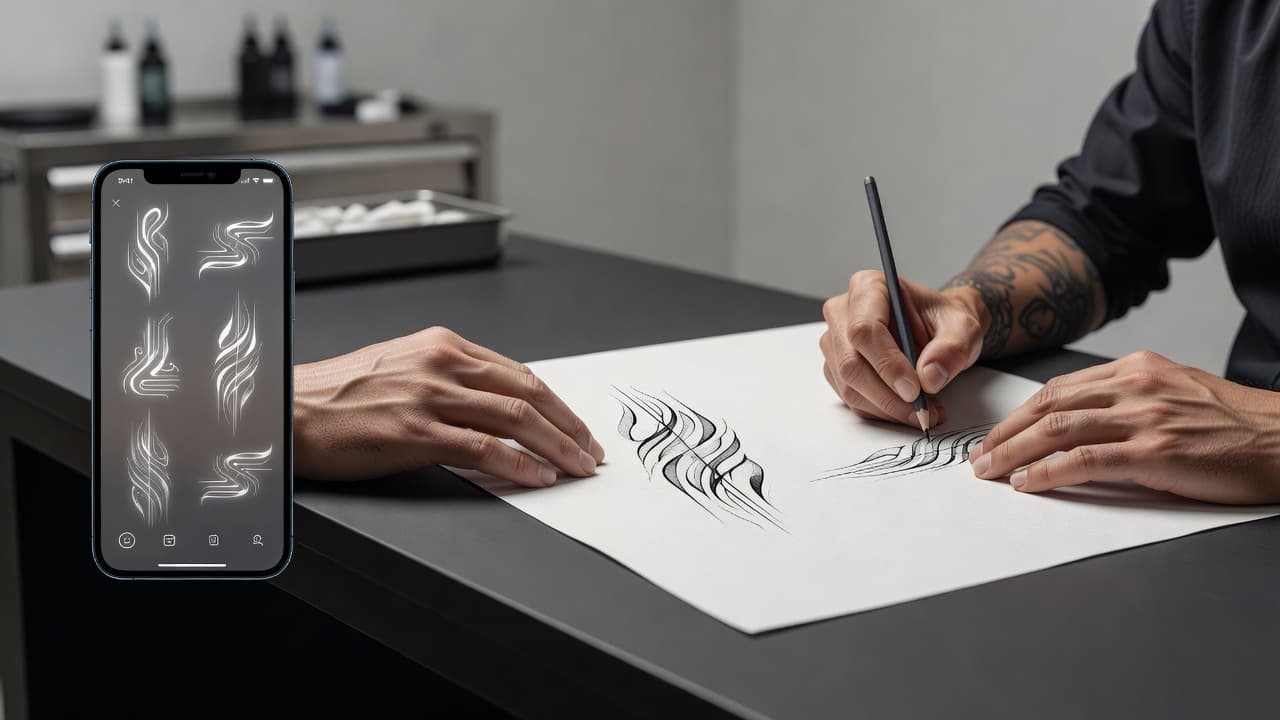
You typed an idea, an AI drew it, and a design you genuinely love is sitting on your phone. Before you book the appointment, one question surfaces: who actually owns this? The honest answer is that "ownership" means three different things here, and nearly all the confusion online comes from collapsing them into one.
In short: designs you generate in INK are yours to use — take them to an artist, get them tattooed, share them, with no restriction from the app. Whether the image also carries a registrable copyright is a separate question, and the answer depends on where you live: the US Copyright Office requires human authorship and has refused registration for purely AI-generated images, the UK has a specific statutory provision for computer-generated works, and the EU and Germany generally require a human creative contribution. And once ink is in skin, the picture shifts a third time — in several documented US lawsuits, the party holding copyright in a tattoo was the artist who drew it, not the person wearing it.
This is general information about how the law currently stands, not legal advice — if real money or an actual dispute is involved, speak to a lawyer in your own country.
Three Questions People Keep Mixing Up
"Who owns an AI-generated tattoo" is really three different questions, and their answers do not line up with each other at all:
- Am I allowed to use this design? A contract question, answered by the app's terms of service — the practical one, and the easiest to settle.
- Can this image be copyrighted? A statutory question, answered differently in the US, UK and EU. It decides whether you can stop other people reusing your design.
- Who owns the tattoo once it is on my body? A question about the artwork your tattooist made on your skin — the least intuitive of the three.
Answer only the first and you can walk away with a badly wrong impression of what you hold.
Question 1: Does the App Let You Use the Design?
This is a matter of contract, not copyright law, and it governs almost everything you will actually do with your design. Whatever the deeper legal theory, what decides whether you can walk a picture into a studio on Saturday is what the tool's terms say.
With INK, the answer is simple: designs you generate belong to you. That includes taking them to a tattoo artist and having them permanently inked, sharing them, and keeping them. INK places no restriction on personal use, on getting a design tattooed, or on sharing it. The complete usage terms live on the INK terms page.
Not every AI image tool works this way. Some free web generators reserve broad rights over what you produce, restrict output to non-commercial use, or license themselves to reuse your images in marketing. Our roundup of the best AI tattoo generator apps is a starting point, but check each tool's terms yourself.
Question 2: Can an AI-Generated Image Be Copyrighted?
Here things get genuinely unsettled, and confident answers online deserve suspicion. Copyright is territorial: there is no global rule, and the countries most people ask from have landed in different places.
The United States is the clearest and the strictest. The US Copyright Office applies a human authorship requirement and has refused or cancelled registration for images generated by AI from a text prompt alone, reasoning that a prompt is closer to an instruction than an act of authorship — a position that has been tested in court and upheld. It is not all-or-nothing, though: where a human meaningfully edits, arranges, or adds original material, those contributions can be registered even though the AI-generated parts cannot. The Office publishes its guidance on copyright and artificial intelligence directly.
The United Kingdom is the outlier. Section 9(3) of the Copyright, Designs and Patents Act 1988 provides for computer-generated works with no human author, assigning authorship to "the person by whom the arrangements necessary for the creation of the work are undertaken." It was drafted long before modern generative AI, and commentators disagree about how well it maps onto today's tools. Treat it as an open question, not a guarantee.
In the EU and Germany, protection generally attaches to a work that is the author's own intellectual creation — in German, a persönliche geistige Schöpfung. There is no equivalent to the UK provision. So for Urheberrecht bei KI-generierten Tattoo-Vorlagen: a design made by typing a prompt and accepting the output is unlikely to attract copyright on its own, while your own creative choices in shaping the result may well do.
| Jurisdiction | Purely AI-generated image | What that means for you |
|---|---|---|
| United States | Not registrable without human authorship | Your human edits and arrangement can be protected; the raw AI output is not |
| United Kingdom | Possibly protected under the computer-generated works provision | A statutory route exists, but its application to modern AI is contested |
| EU / Germany | Generally requires a human creative contribution | Prompt-only output likely unprotected; your own creative input may qualify |
What the table does not say, because it is not true anywhere: that an unprotected image is illegal or off-limits. "Not copyrightable" is not "not usable" — it only means you may have limited ability to stop someone else copying it.
Question 3: Who Owns the Tattoo Once It Is on Your Skin?
This is the most under-discussed part of the subject, and the one that surprises people most. You own your body. You do not automatically own the copyright in the artwork on it.
Tattoos are original artistic works, and in most systems the person who created a work is its author. A tattooist who draws or substantially adapts a design and applies it to skin is producing artwork — and may hold copyright in it, even though the only copy in existence is on someone else's arm.
That is not theoretical. Two documented US cases put it in front of courts, both involving video games that recreated real athletes complete with their real tattoos. In Solid Oak Sketches v. 2K Games, decided in 2020, a company holding rights to tattoos worn by several NBA players sued over their appearance in a basketball game; the court found for the game maker, on reasoning including that the use was minimal, that an implied licence existed for the players to be depicted as they appear, and that the use was fair. In Alexander v. Take-Two Interactive, an artist sued over tattoos she had created for wrestler Randy Orton; that case reached a jury in 2022, which found infringement but awarded a notably small sum in damages.
Read together, they do not settle the law so much as show it is unsettled — different courts, similar facts, different outcomes. What they do establish is that the question is real: a tattoo artist can plausibly assert copyright in work inked on someone else's body.
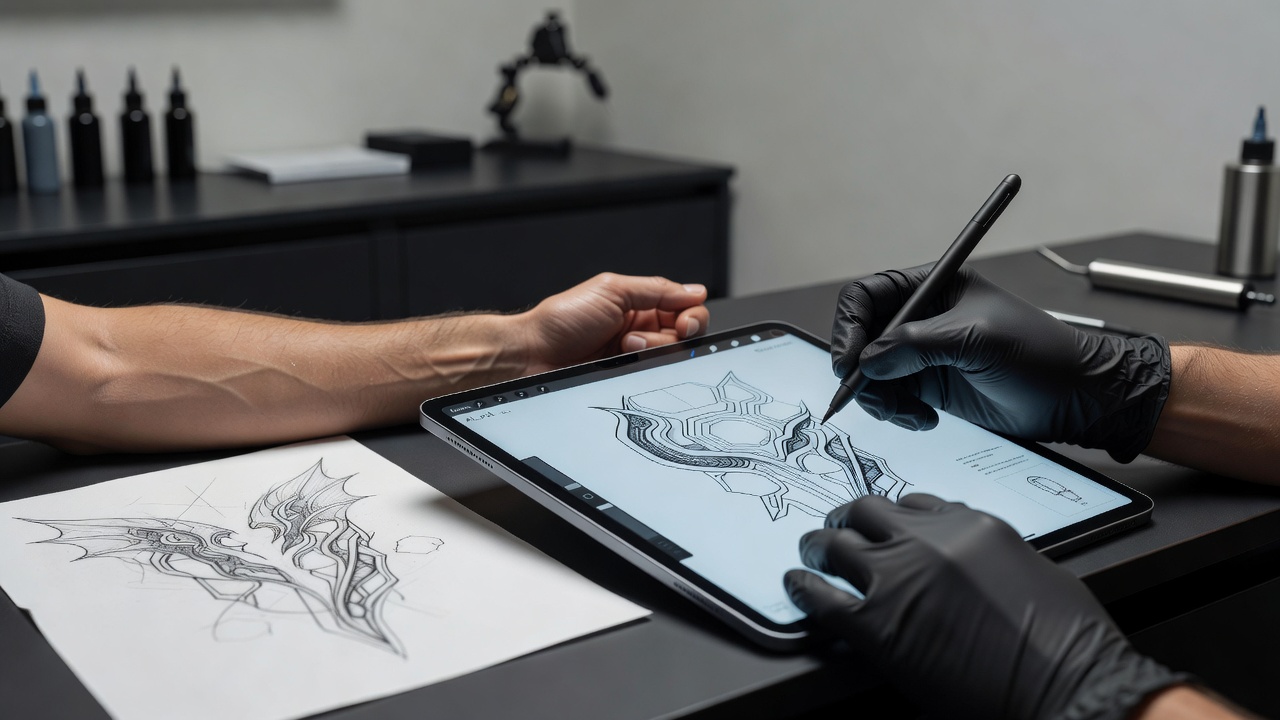
For everyday life this touches nothing: nobody will stop you photographing your own tattoo or posting it. It matters at the edges — commercial reproduction, advertising, merchandise, film and games. It also interacts with AI: the more heavily your artist redraws your generated design, the more of the finished tattoo is genuinely their creative work. That collaboration is a strength, as we cover in our piece on AI versus human tattoo artists. If you can foresee commercial use, raise it before the session and write down what you agree.
Can You Use an AI Tattoo Design Commercially?
This question has two halves, and people usually ask only the first.
Am I permitted to? Under INK's terms the designs you generate are yours, so nothing in the app stands between you and commercial use. Check the terms for the specifics, and note one practical detail: free exports carry a small watermark, while Pro removes it and unlocks high-resolution export.
Can I stop anyone else? Here the copyrightability question comes back to bite. If a purely AI-generated image is not protected where you live, you may have little ability to prevent a competitor using an identical one. For a personal tattoo that is irrelevant; for a brand identity, a merchandise line, or a studio's flash catalogue it is real exposure. The standard mitigation is meaningful human work on top of the generated base — exactly what strengthens your position under the US and EU analyses above.
"Not copyrightable" and "not allowed" are completely different statements. Almost every anxious question about AI tattoo copyright dissolves once you separate them.
The Real Risk: What You Feed the Generator
Here is the part that matters far more than anything above, and gets a fraction of the attention. The genuine legal exposure in AI tattoo design is almost never about the AI. It is about what you asked it to reproduce. Two inputs carry actual risk:
- Someone else's existing tattoo. A custom piece you admired on Instagram is artwork by an identifiable artist. Uploading a photo of it and asking for something close is the most common way people create a real problem — and it is poor etiquette in a culture where custom work belongs to the person it was made for.
- Copyrighted characters and protected works. Film and game characters, anime, comic panels, logos and album art are all protected. Rights holders have essentially never pursued private individuals over a personal tattoo, so the risk of one piece on your own arm is close to zero. Exposure appears the moment it is sold, printed, advertised, or reproduced as flash.
The fix is simple: start from an idea, not an image of somebody's finished work. Working from a photo — a pet, a place, a portrait — use one you took, which is what the photo-to-tattoo tool is for. Working from inspiration, describe it instead: subject, style, mood, composition. Our complete guide to AI tattoo generators covers getting a strong result from a description alone.
How to Keep Your AI Tattoo Design Legally Clean
A short, honest checklist. Follow it and most of what people worry about never arises.
- Read the tool's terms once and confirm the output is yours before you get attached to a design. In INK it is.
- Begin with your own idea or your own photo — not a screenshot of another person's custom tattoo.
- Avoid protected characters if there is a commercial angle. For a personal piece the risk is negligible; for anything you sell, it is not.
- Do real human work on the result. Editing, arranging and combining are what create protectable authorship in the US and EU — and usually a better tattoo too.
- Discuss reproduction with your artist up front if the tattoo might ever appear commercially. A written note beats an awkward conversation later.
- Get local advice when it counts. If a design underpins a business, a lawyer in your country beats any article, including this one.
For most people the exercise ends at step two: a tattoo you love, from your own idea, on your own skin, by an artist you trust — no legal wrinkle in that at all. Our walkthrough of how to use an AI tattoo generator takes it from blank screen to finished design, and you can do all of it on the free tier first.
The Final Word
How safe are AI-generated tattoos where copyright is concerned? For personal use — the reason nearly everyone opens a tattoo generator — very safe. INK's designs are yours, including to get tattooed, and no rights holder has any interest in a private tattoo drawn from your own idea. The real complications sit in two narrow places: reproducing somebody else's protected work, and commercially exploiting an image that may not be copyrightable.
The law is unsettled and moving, and anyone telling you otherwise is overselling. What is not unsettled is the practical path: bring your own idea, generate something original, add your own judgement, and take it to an artist who will make it theirs as well as yours. That is a good tattoo and a clean legal position at once.
Design a Tattoo That's Yours
Generate original tattoo designs from your own idea across 40 styles — free, no sign-up, and yours to take straight to your artist.
Try INK Free →

Create Your Perfect Tattoo Design
Use AI to generate unique tattoo designs and preview them on your body before committing to ink.
Start Designing for FreeWritten by

Laura Schmitz
Tattoo Content Lead, INK
Laura Schmitz leads tattoo content at INK. She has spent years researching tattoo styles, symbolism and aftercare, and works directly with the AI tattoo generator to test how each style translates from prompt to skin — so every guide here reflects designs that are actually tattooable, not just images that look good on screen.
More about the author