
What Do Tattoos Mean? A Cross-Cultural Symbolism Guide
A cross-cultural guide to tattoo meanings — animals, plants, religious symbols, cultural traditions, and how to find your own personal meaning.

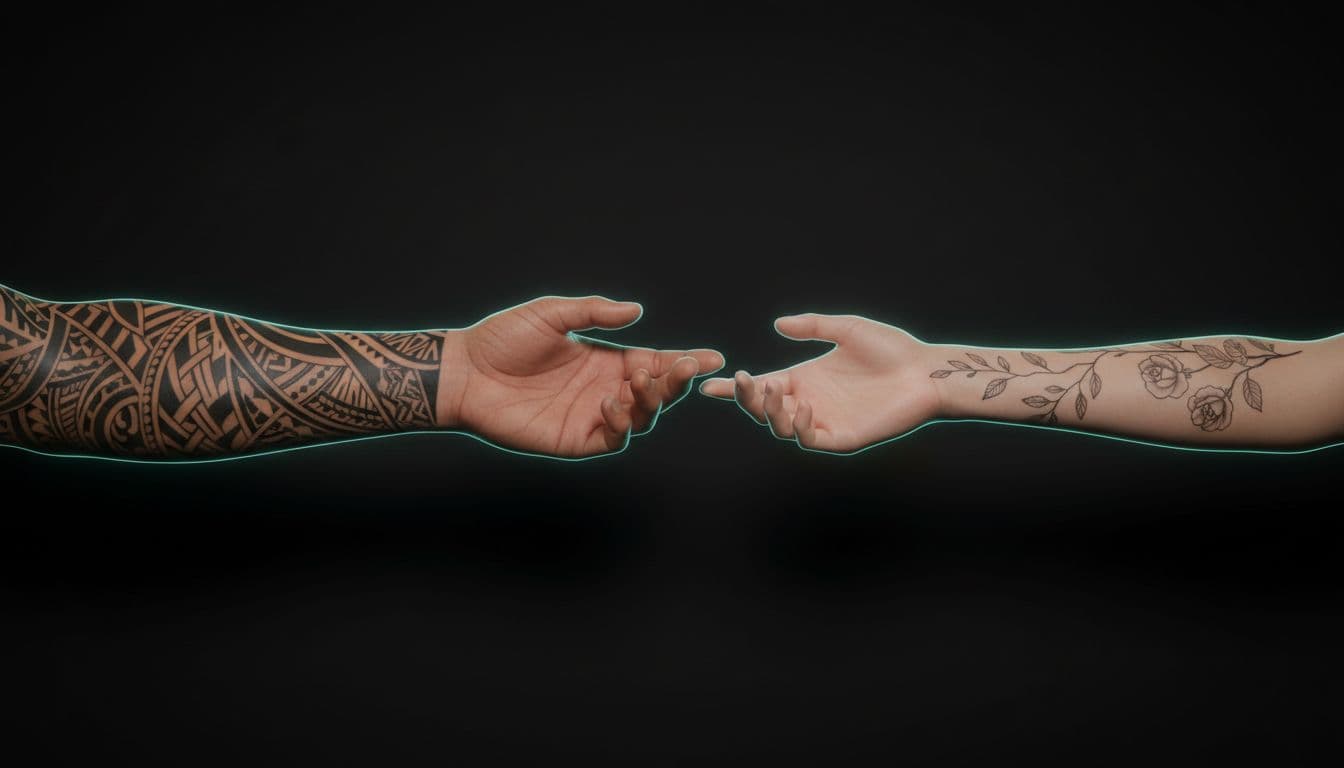
"What do tattoos mean?" is one of the most-asked questions in tattoo culture — and the honest answer is: whatever the person wearing them decides they mean. But across thousands of years and dozens of cultures, certain symbols and motifs have carried remarkably consistent meanings. Understanding that history makes any tattoo more powerful, even if you ultimately choose meaning that's purely personal.
This guide covers the cross-cultural symbolism behind common tattoo subjects, the universal reasons people get tattooed in the first place, and how to find — or design — meaning that feels authentic to you.
The Universal Reasons People Get Tattoos
Despite enormous cultural variation, almost every tattoo throughout human history fits into one of these motivations:
- Identity — Marking who you are, who you belong to, what tribe you serve
- Memorial — Honoring someone who has died or a major life event
- Protection — Symbols believed to ward off harm or bring strength
- Status — Tattoos earned through achievement, rite of passage, or rank
- Spirituality — Connection to gods, ancestors, or spiritual beliefs
- Beauty — Pure aesthetic expression, body as canvas
- Storytelling — Permanent record of a life event or chapter
Modern tattooing in the West tends to blend several of these. A memorial portrait is identity + memorial. A religious symbol is spirituality + protection. The motivations are ancient even when the designs are contemporary.
Cultural Symbolism Across Traditions
Polynesian and Pacific Traditions
Polynesian tattooing (Samoa, Tonga, Tahiti, Hawaii, Maori in New Zealand) is one of the oldest documented tattoo traditions. Patterns are highly symbolic and read like a personal biography — family lineage, achievements, social rank, spiritual beliefs all encoded in geometric designs. Specific patterns are often considered sacred and inappropriate for outsiders to wear.
Japanese Irezumi
Japanese tattooing carries deep symbolism in every element. Koi fish represent perseverance and transformation. Dragons embody wisdom and strength. Cherry blossoms signify the beauty and brevity of life. Full-body Japanese suits often tell a complete narrative across decades of work. Our Japanese tattoo style guide covers this in detail.
Indigenous American Traditions
Many Indigenous American cultures have rich tattoo traditions tied to spiritual beliefs, healing, and identity. Specific patterns and animals carry tribal significance, and many designs are considered closed practices reserved for community members.
Celtic and Norse
Celtic knots represent eternity and interconnection. The triskelion symbolizes life, death, and rebirth. Norse runes carry specific meanings — though some have been co-opted by hate groups, requiring careful research before use.
Thai Sak Yant and Buddhist Traditions
Sak Yant tattoos in Thailand and Cambodia are sacred geometric and Sanskrit designs blessed by monks for protection, luck, or specific powers. Traditional sak yant is performed by monks or shamans, not commercial artists.
Modern Western Tattooing
Contemporary Western tattooing borrows from all of these traditions plus its own iconography: anchors, swallows, roses, hearts, daggers. Sailor Jerry-style traditional tattoos developed their own vocabulary in the early 20th century — anchors mean stability, swallows mean returning home, roses mean love and beauty.
Animal Symbolism
Animals are some of the most common tattoo subjects, and their meanings appear strikingly consistent across cultures:
- Wolf — Loyalty, family, primal instinct, leadership
- Lion — Courage, royalty, strength, protection
- Eagle — Freedom, vision, power, spiritual messenger
- Owl — Wisdom, intuition, mystery, the unseen
- Snake — Transformation, healing, rebirth (in Western: also temptation)
- Butterfly — Transformation, soul, fragility, rebirth
- Bear — Strength, protection, motherhood, courage
- Phoenix — Rebirth, immortality, rising from destruction
- Tiger — Power, sensuality, protection from evil (Asian traditions)
- Hummingbird — Joy, presence, energy, healing
Plant and Nature Symbolism
- Rose — Love, beauty, secrecy (color matters: red for love, white for purity, black for grief)
- Lotus — Spiritual awakening, rising above suffering (Eastern traditions)
- Tree of Life — Family, ancestry, growth, interconnection
- Oak — Strength, endurance, wisdom
- Cherry blossom — Brevity of life, beauty in transience
- Olive branch — Peace, victory, healing
- Mountains — Stability, achievement, the spiritual journey
- Waves — Change, emotion, life's cycles
- Sun — Life force, masculinity, energy, rebirth (daily cycles)
- Moon — Femininity, intuition, cycles, hidden knowledge
Religious and Spiritual Symbols
Religious tattoos require special thoughtfulness. Many cross faiths but carry intense personal weight to believers.
- Cross — Christian faith; specific styles (Celtic, Orthodox) carry additional meaning
- Om — Universal sound, the source of all in Hindu tradition
- Hamsa hand — Protection from evil eye (Middle Eastern, Jewish, Islamic)
- Buddha — Enlightenment, peace (carries cultural sensitivity in some Buddhist contexts)
- Mandala — Universe, balance, spiritual journey
- Star of David — Jewish identity, faith, protection
- Ankh — Egyptian symbol of eternal life
If you wear a religious symbol you don't practice, be ready to explain why. People notice.
Numbers and Letters
Numbers carry coded meaning depending on cultural context. Birthdates, anniversaries, lucky numbers, addresses of meaningful places, jersey numbers of fallen friends. Letters can stand alone (initials of loved ones), spell out words (single-word knuckle tattoos — see our knuckle tattoo guide), or combine into phrases.
Be aware that some number combinations have been co-opted by hate groups (88, 14, 1488). Research any number combination before committing.
Memorial Tattoos
Memorial tattoos are some of the most personal in modern tattooing. Common approaches:
- Portraits of loved ones (humans or pets)
- Names with meaningful dates
- Symbols meaningful to the person being remembered
- Handwriting or signatures of the deceased
- Quotes or song lyrics that capture their voice
- Their favorite flowers, animals, or imagery
Memorial tattoos benefit hugely from the two-week wait rule. Grief makes us want immediate, permanent acknowledgment — which sometimes leads to tattoos we love forever, and sometimes to ones we'd rather adjust later.
Modern Personal Symbols
Some of the most powerful tattoos have meanings invented by the wearer alone. A symbol from a meaningful book. A coordinate from where you grew up. A drawing your child made. A geometric pattern from your wedding venue ceiling. The meaning doesn't need cultural pedigree to be valid — it just needs to matter to you.
How to Find YOUR Meaning Before You Ink
If you want a meaningful tattoo but don't know where to start, work backward:
- What do I want to remember or honor? A person, an event, a chapter, a value, a goal.
- What images naturally come to mind? Don't force it — what arrives unprompted is usually right.
- What symbols or traditions speak to me? Research without committing.
- How would I describe this in three words? Reduce to essence.
- What style fits the meaning? Solemn meanings often need restrained styles.
From there, AI design tools let you explore visual interpretations rapidly. Generate variations, refine, sit with your favorites for two weeks. The combination of clear meaning and clear visual usually produces a tattoo you'll love for life.
Tattoo Meaning FAQ
Do all tattoos need to have meaning? No. Pure aesthetic appreciation is a valid reason on its own.
What are the most universally meaningful symbols? Trees, water, birds, sun and moon, hearts. Their specifics vary across cultures but the broad meanings recur.
Is it okay to get a tattoo from another culture? Decorative motifs that exist across many cultures are usually acceptable. Sacred symbols belonging to specific traditions (Maori moko, certain Indigenous patterns) are generally off-limits for outsiders.
How do I find a meaningful tattoo for myself? Start with what you want to remember or honor. The visual follows from the meaning.
Tattoo meaning isn't about finding the "correct" symbol — it's about choosing imagery that connects something inside you to something on your skin. Whether you draw on ancient traditions or invent meaning entirely your own, what matters is that it stays meaningful to you the day you get it and decades later.
Design a Tattoo With Meaning
Start with what matters to you, then explore visual interpretations with AI. INK helps you find the design that captures your meaning perfectly.
Find Your Design Free →

Create Your Perfect Tattoo Design
Use AI to generate unique tattoo designs and preview them on your body before committing to ink.
Start Designing for FreeWritten by

Laura Schmitz
Tattoo Content Lead, INK
Laura Schmitz leads tattoo content at INK. She has spent years researching tattoo styles, symbolism and aftercare, and works directly with the AI tattoo generator to test how each style translates from prompt to skin — so every guide here reflects designs that are actually tattooable, not just images that look good on screen.
More about the author