
How Tattoos Are Made: The Complete Tattoo Process Explained
Learn how tattoos are done step-by-step. Understand tattoo machines, ink composition, needle techniques, and what happens to your skin during tattooing.

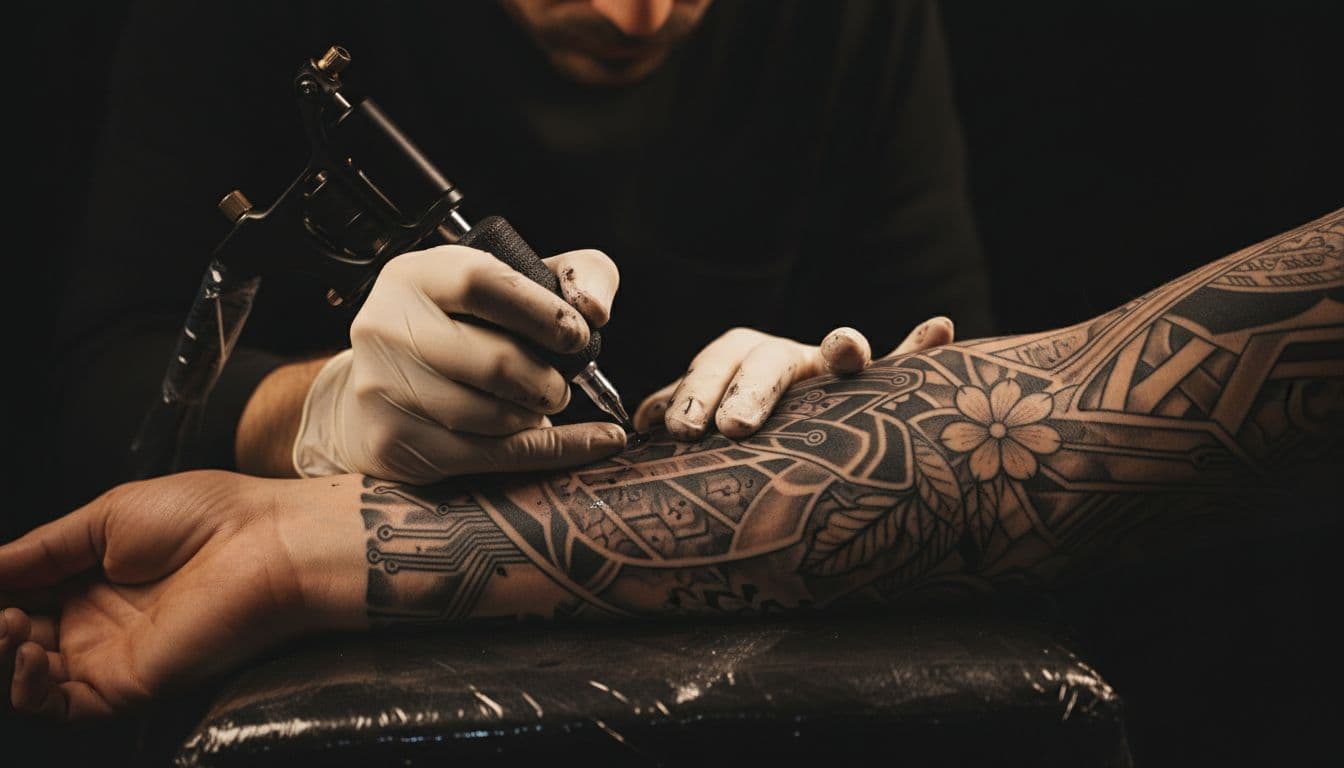
Ever watched a tattoo being done and wondered what's actually happening beneath the surface? There's fascinating science behind how permanent ink ends up living in your skin forever. Understanding the process doesn't just satisfy curiosity—it helps you make better decisions about your own tattoos and take better care of them.
From the mechanics of tattoo machines to the biology of why ink stays put, let's explore how tattoos are made and what's really going on during your session.
The Science Behind Tattooing
At its core, tattooing is the process of depositing ink into the dermis—the second layer of your skin. This is what makes tattoos permanent. The epidermis (outer layer) constantly sheds and regenerates, but the dermis is stable. Ink particles placed there stay put.
Here's what happens at the cellular level:
- Needle penetration: The tattoo needle punctures through the epidermis into the dermis, creating tiny wounds
- Ink deposit: As the needle withdraws, it leaves ink particles in the dermis layer
- Immune response: Your body recognizes the ink as a foreign substance and sends immune cells (macrophages) to "eat" the particles
- Trapped ink: The macrophages can't digest the ink particles—they're too large. So they stay in place, holding the ink permanently
- Healing: The epidermis heals over the top, sealing the ink in the dermis
According to research published in the Scientific American, tattoo ink particles are essentially "eaten" by immune cells that then become permanent residents of your skin—a biological loophole that makes permanent body art possible.
This is also why tattoos fade over time. Some ink particles eventually break down or get carried away by your lymphatic system. Sun exposure accelerates this process by breaking down ink particles faster.
Tattoo Machines: How They Work
Modern tattoo machines are precision instruments that drive needles into skin at controlled depths and speeds. There are several types, each with distinct characteristics.
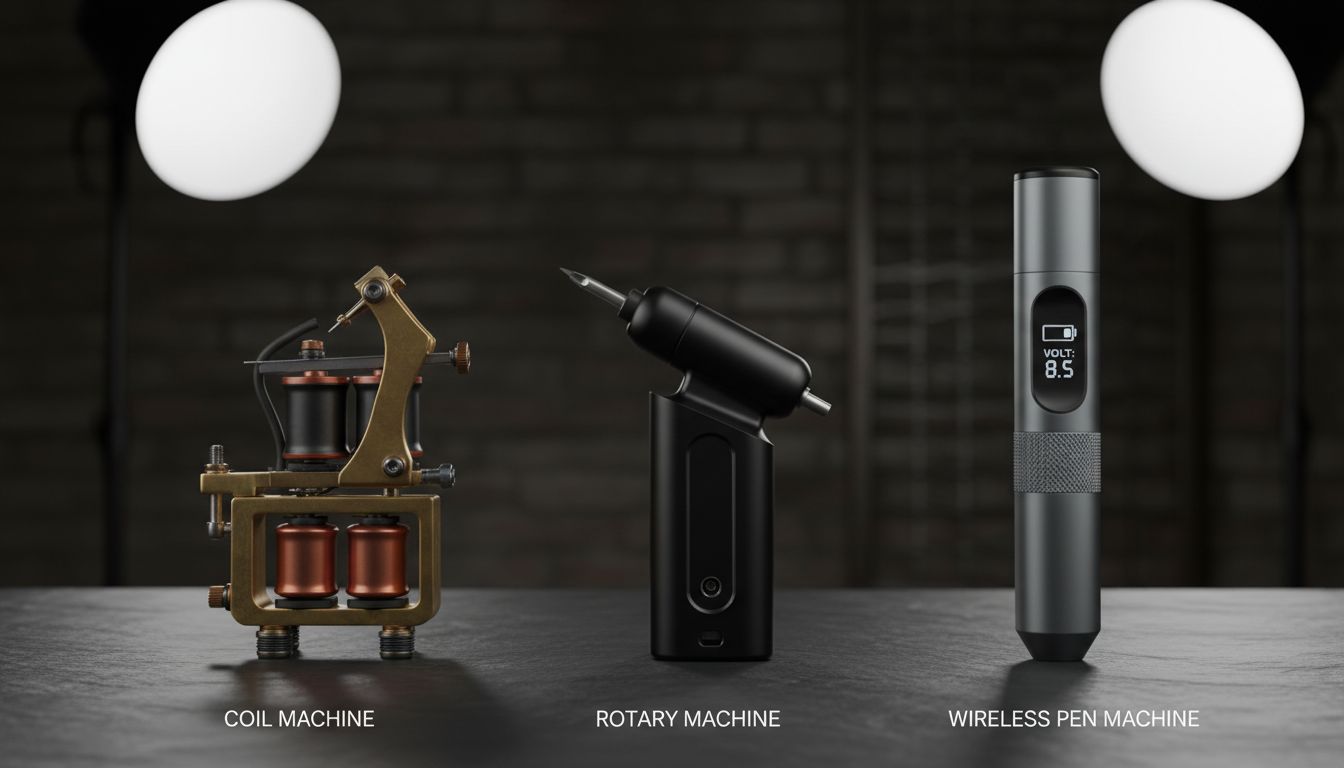
Coil Machines
The classic tattoo machine you've probably seen in movies. Two electromagnetic coils pull a metal bar (armature bar) up and down, driving the attached needle grouping. The distinctive buzzing sound? That's the coils rapidly activating.
Characteristics:
- Heavier, requires more skill to use
- Highly customizable—artists can tune them precisely
- Separate machines typically needed for lining vs. shading
- The traditional choice many experienced artists prefer
Rotary Machines
Use a motor to drive the needle in a smooth, consistent motion. Quieter and lighter than coil machines, they've become increasingly popular.
Characteristics:
- Quieter operation
- Lighter weight—less hand fatigue for artists
- Can handle both lining and shading with adjustments
- Gentler on skin in many cases
Pen-Style Machines
The newest generation. These ergonomic devices look like large pens and often feature wireless operation. They're becoming the industry standard for many modern artists.
Characteristics:
- Most ergonomic design
- Often wireless/cordless
- Precise digital controls
- Easiest to sterilize
Regardless of type, all machines serve the same purpose: driving needles into skin at speeds typically between 50-3,000 times per minute, depending on the technique being used.
Tattoo Ink: What's Really In It
So what is tattoo ink actually made of? It's more complex than you might think—and less regulated than many people realize.
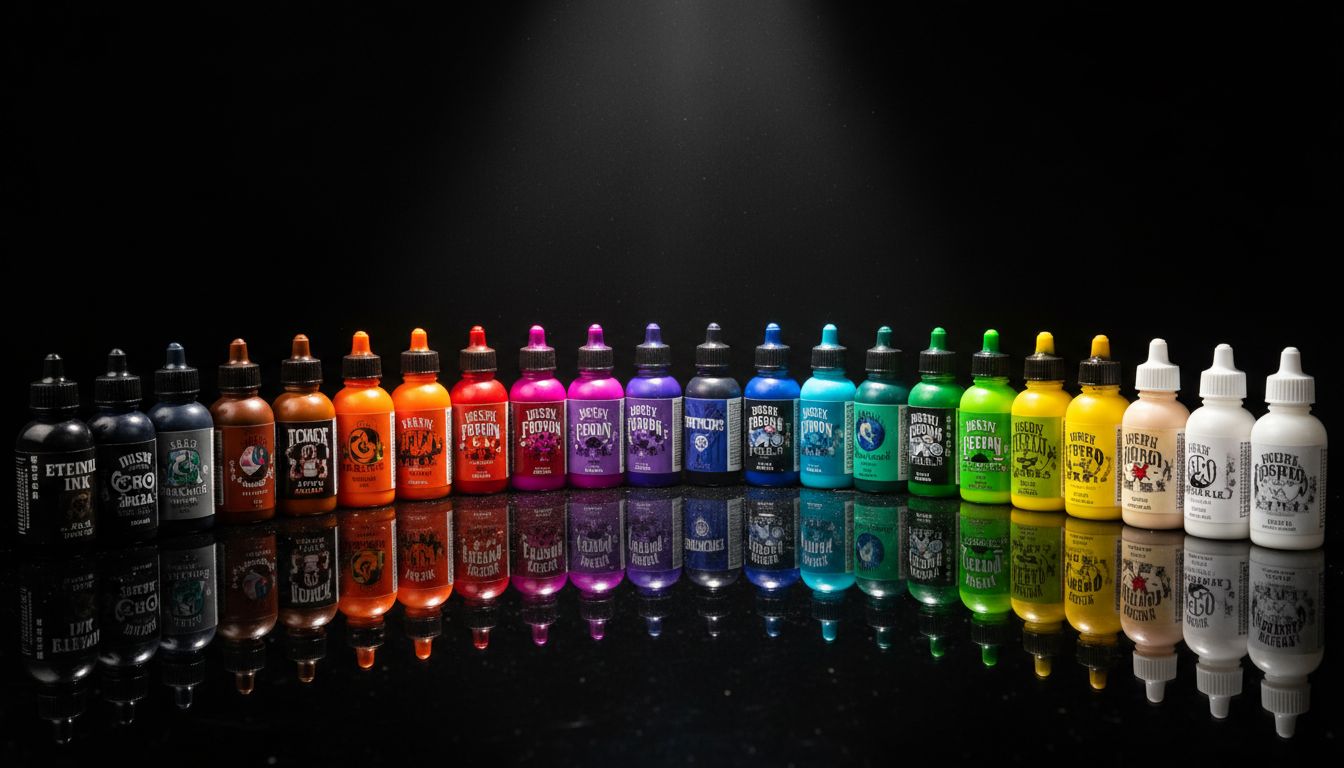
Tattoo ink consists of two main components:
1. Pigments (the color)
These can be made from various sources:
- Metal salts: Iron oxide (black, brown), titanium dioxide (white), chromium oxide (green)
- Organic compounds: Carbon-based molecules for various colors
- Plastics: Some modern bright colors use plastic-based pigments
2. Carrier solution (the liquid)
This suspends the pigment and helps it penetrate the skin evenly:
- Distilled water
- Witch hazel
- Glycerin
- Ethanol or other alcohols
The FDA notes that while they have authority to regulate tattoo inks, they haven't traditionally exercised it extensively. Most ink safety comes from manufacturer standards and artist discretion.
Color considerations:
- Black: Most stable, least likely to cause reactions
- Red: Most common to cause allergic reactions
- Yellow/Orange: Can be photosensitive (react to sunlight)
- White: Often fades fastest, can yellow over time
Design Your Tattoo Before the Appointment
Use AI to generate and refine your design before sitting in the chair. Free on iOS and Android.


The Tattooing Process Step by Step
Here's what actually happens during your tattoo session, from start to finish:
1. Design Preparation
Before any needles touch skin, your design needs to be finalized. This might involve:
- Reviewing reference images or AI-generated concepts
- Artist sketching or modifying the design
- Sizing to fit the placement
- Creating a stencil (thermal transfer or freehand drawing)
2. Skin Preparation
The tattoo area is cleaned, shaved (if necessary), and the stencil is applied. You'll approve the placement before anything permanent happens.
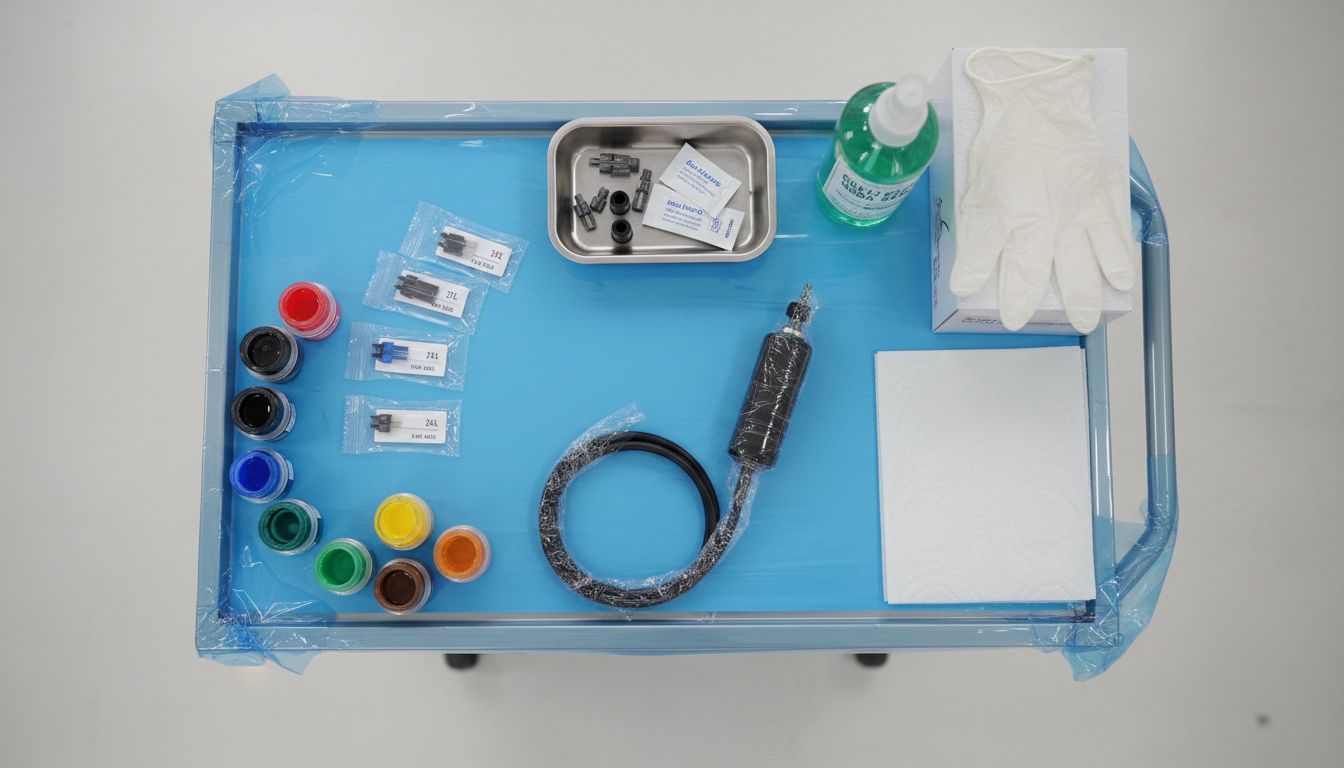
3. Station Setup
Everything is sterile: fresh needles (never reused), ink poured into single-use caps, barriers on equipment, artist wearing gloves. Proper sanitation is non-negotiable.
4. Outlining
The artist starts with the outline using liner needles—tight groupings that create clean, defined lines. This establishes the tattoo's structure. Liner needles are configured in round patterns (like 3RL, 5RL, etc.—the number indicates how many needles in the grouping).
5. Shading
After the outline, shading needles (magnum or curved configurations) add depth, gradients, and dimension. These spread ink more broadly for softer effects.
6. Color Packing
If your tattoo includes color, this comes next. The artist "packs" color into areas defined by the outline, working from lighter to darker shades typically.
7. Final Touches and Cleanup
The artist cleans the tattoo, checks for any spots needing touch-up, and applies aftercare products and wrapping.
What Happens to Your Skin
Let's zoom in on what's happening at the skin level during and after tattooing.
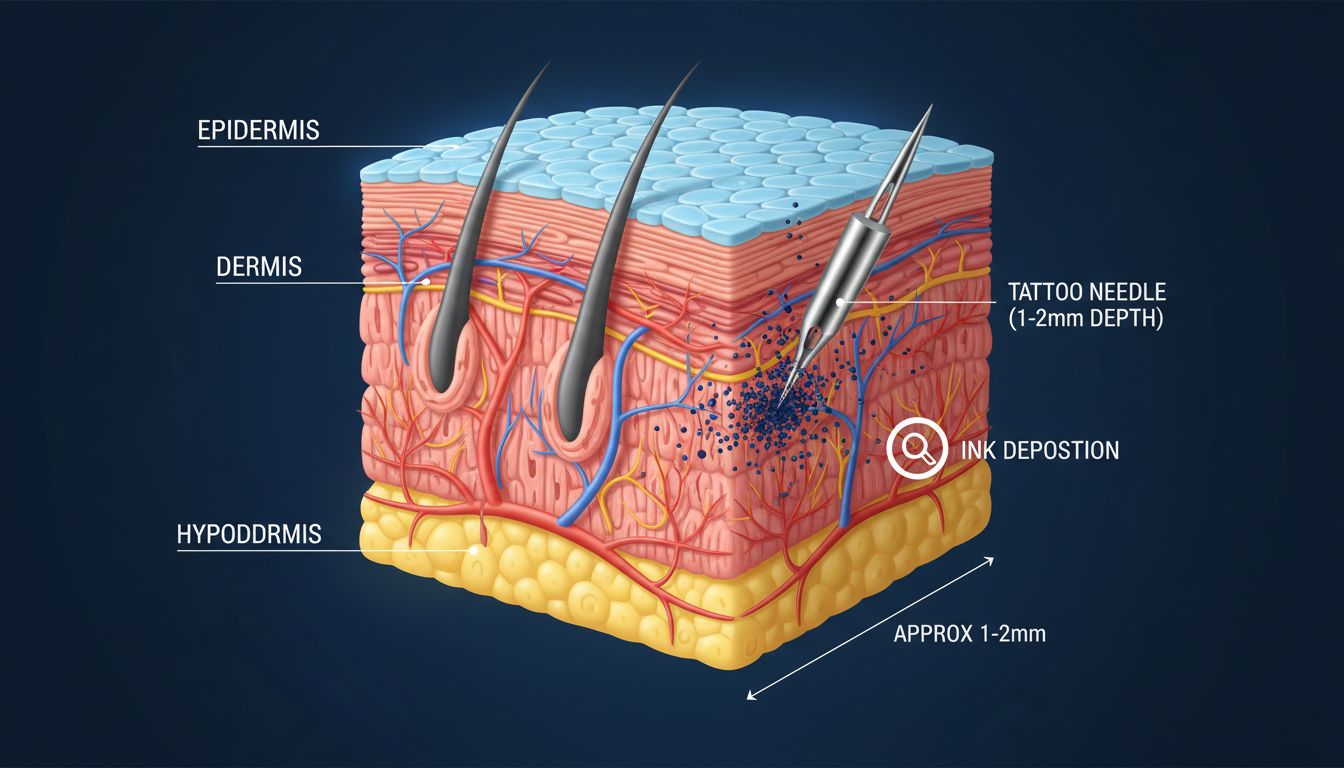
During tattooing:
- Needles puncture 1-2mm deep—through the epidermis into the dermis
- Each puncture deposits a tiny amount of ink
- Blood and plasma appear as the body responds to the trauma
- Thousands of these punctures create the complete image
Immediately after:
- The area is essentially an open wound
- Inflammation causes redness and swelling
- Your immune system kicks into high gear
- Plasma may ooze from the wound
Healing process:
- Days 1-3: Initial healing, scabbing begins
- Days 4-14: Peeling and itching as epidermis regenerates
- Weeks 2-4: Surface appears healed
- Months 1-3: Deep layers fully heal, ink settles into final appearance
For detailed aftercare instructions, check our complete tattoo aftercare guide.
Needles and Techniques
Different needle configurations serve different purposes:
Round Liners (RL): Needles arranged in a tight circle. Used for outlines, fine details, and script. Numbers indicate needle count (3RL = 3 needles, 9RL = 9 needles).
Round Shaders (RS): Similar arrangement but looser spacing. Used for shading smaller areas and some color work.
Magnums (M1, M2): Needles arranged in rows. Used for shading, color packing, and covering larger areas. Flat magnums (M1) have one row; stacked magnums (M2) have offset rows.
Curved Magnums: Magnum configuration with an arched shape. Conforms to body curves better, gentler on skin.
Skilled artists switch between needle types throughout a session, choosing the right tool for each part of the design.
Preparing Your Design with AI
One of the most valuable ways to prepare for your tattoo is having a clear design ready. This is where AI tattoo generators become incredibly useful.
Benefits of AI design preparation:
- Visual clarity: Show your artist exactly what you're envisioning instead of trying to describe it
- Style exploration: Test different styles before committing
- Size and placement: Preview how designs look in different spots on your body
- Refinement: Iterate on concepts until you find exactly what you want
- Time savings: Come to your consultation with concrete starting points
The AI design serves as a communication tool and starting point. Your tattoo artist will adapt it for skin—adjusting sizing, line weights, and details to ensure it tattoos well and ages gracefully.
For guidance on working with AI designs, see our complete AI tattoo generator guide.
Ready to Create Your Design?
Now that you understand how tattoos work, design your own with AI. Generate custom concepts, preview placements, and walk into your appointment prepared.
Start Designing Free →
Create Your Perfect Tattoo Design
Use AI to generate unique tattoo designs and preview them on your body before committing to ink.
Start Designing for FreeWritten by

Laura Schmitz
Tattoo Content Lead, INK
Laura Schmitz leads tattoo content at INK. She has spent years researching tattoo styles, symbolism and aftercare, and works directly with the AI tattoo generator to test how each style translates from prompt to skin — so every guide here reflects designs that are actually tattooable, not just images that look good on screen.
More about the author