Blackwork Tattoo Designs: Bold Black Ink Ideas, Styles & AI Examples
A complete guide to blackwork tattoos — history, sub-styles, placement, healing, and how to design your own with AI.
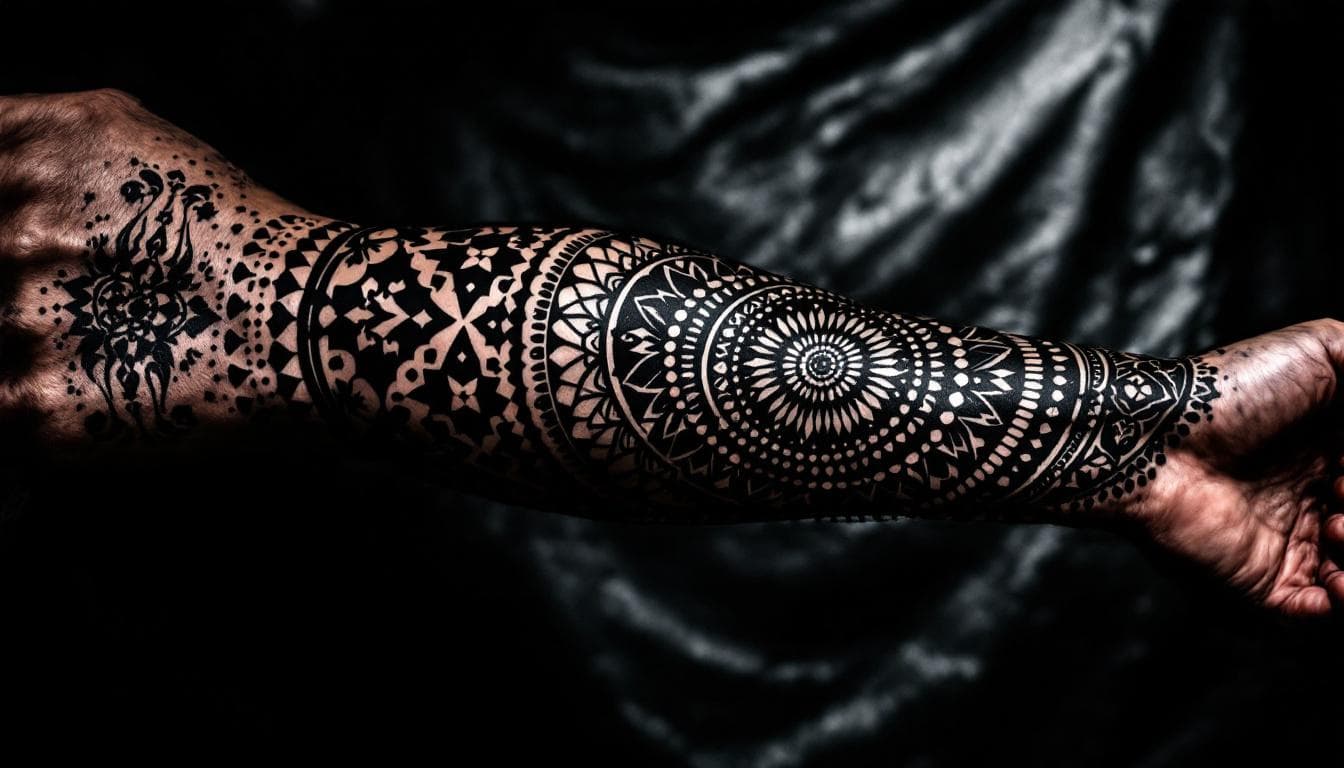
Few tattoo styles hit as hard at first glance as blackwork. No colour, no grey wash — just confident, high-contrast black ink doing all the heavy lifting. Whether it's a delicate ornamental pattern wrapping around a forearm or a full blackout sleeve that looks carved from obsidian, blackwork has become one of the most exciting movements in modern tattooing.
This guide walks you through what blackwork actually is, the major sub-styles you'll see in studios in 2026, where it works best on the body, how to plan and heal it properly, and how to design your own using the INK AI tattoo generator before committing to a needle.
What Is a Blackwork Tattoo?
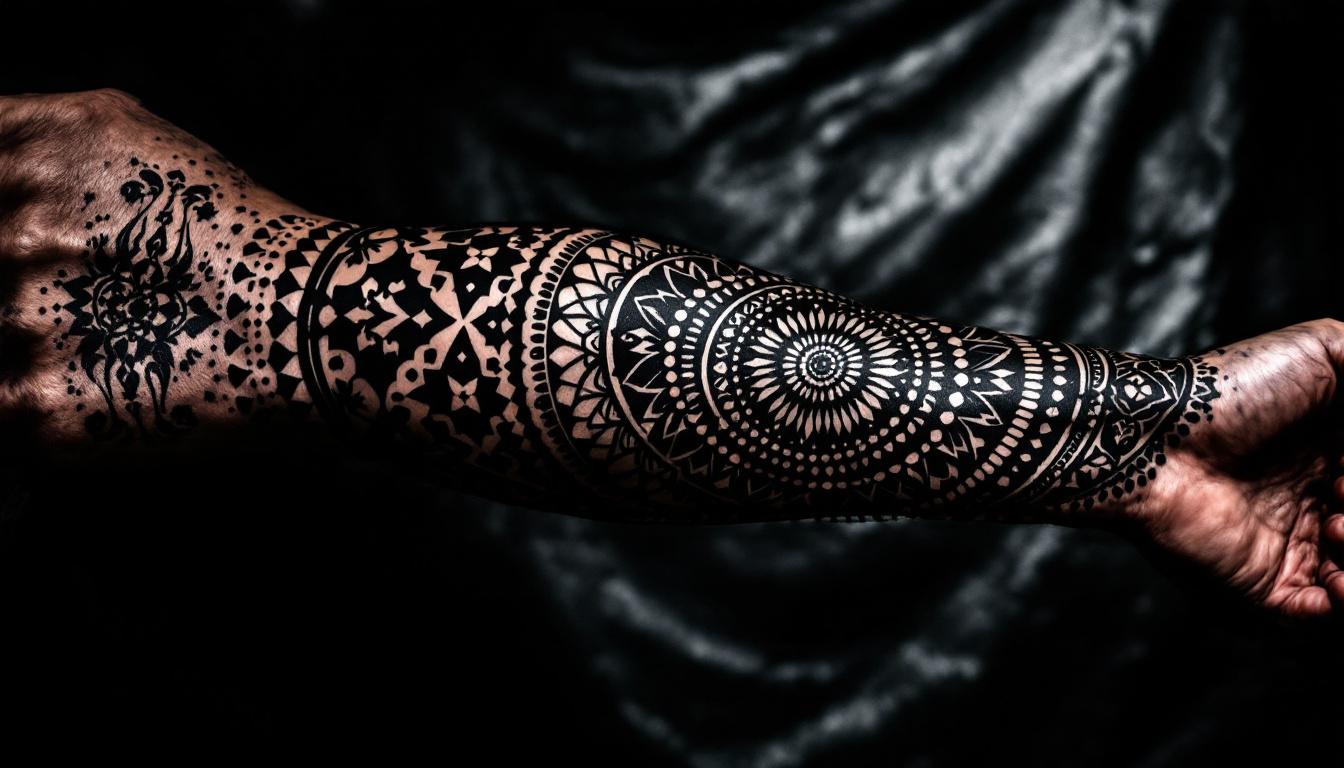
Blackwork is exactly what the name suggests: tattooing done entirely in solid black ink, with no colour and no soft grey washes. The style sits at the intersection of two very old traditions — indigenous tribal tattooing (which has used solid black for thousands of years) and the European woodcut and engraving traditions that fed into early traditional tattoo flash.
What makes modern blackwork distinct is that artists have pushed the format in dramatically different directions. The same "blackwork" label now covers everything from ultra-fine illustrative work that looks like a pen-and-ink etching to massive blackout pieces where entire limbs become solid black. The connective tissue is the disciplined use of contrast: deep black against bare skin, with negative space treated as a design element in its own right.
For broader cultural context, the Wikipedia entry on blackwork tattooing traces the lineage from Polynesian and Iban traditions through to today's contemporary scene.
The Main Sub-Styles of Blackwork
Calling something "a blackwork tattoo" is a bit like calling something "a piece of music" — accurate, but missing the genre. Here are the sub-styles you'll actually be choosing between when you sit down with an artist.
Ornamental Blackwork
Symmetrical, decorative, and inspired by mandalas, henna patterns, and architectural ornament. Ornamental blackwork loves repeating motifs, dotwork shading, and bands that wrap around limbs or follow the body's natural lines. It's quiet from a distance and rewards close inspection. Perfect for forearms, the chest plate, and the back of the hand.
Illustrative Blackwork
This is the style that looks like it was lifted from an antique book of botanical engravings. Fine parallel lines, hatching, stippling, and a strong sense of drawing rather than tattooing. Illustrative blackwork suits naturalistic subjects — plants, animals, anatomy, hands holding objects — where texture is doing as much storytelling as silhouette.
Dotwork
Tonal shading built entirely from thousands of individual dots, rather than solid fills or smooth grey wash. Dotwork takes longer to execute than almost anything else in tattooing — every gradient is hand-stippled — but it produces a soft, almost printed quality that solid black can't reach. Often combined with ornamental blackwork to give patterns a sense of light and shadow.
Blackout Tattoos
The most extreme end of the spectrum: large areas of skin filled solid black, often used to either reclaim an old unwanted tattoo or as a statement piece in its own right. Blackout pieces can be combined with negative-space line art for a "carved" look. They demand serious commitment, very experienced artists, and disciplined aftercare.
Neo-Tribal & Modern Tribal
A respectful evolution of the indigenous tribal traditions that started this whole conversation. Bolder shapes, flowing curves, and a strong sense of movement around the body. We've covered this lineage in detail in our tribal tattoo designs guide.
Where Blackwork Looks Best
Because blackwork is so contrast-heavy, placement matters more than with softer styles. A delicate watercolour piece can land almost anywhere; a bold blackwork band on the wrong spot will fight the body instead of flowing with it.
- Forearms — the classic home of ornamental and illustrative blackwork. Flat enough for detailed designs, visible enough to enjoy daily.
- Outer biceps and shoulder caps — ideal for bolder ornamental or neo-tribal work that follows muscle shape.
- Chest plate and sternum — symmetrical ornamental designs sit beautifully here.
- Spine and back — long vertical real estate for elaborate illustrative or ornamental pieces.
- Calves and thighs — great for blackout work and dense ornamental panels.
If you're still deciding where to place a piece, our best tattoo placements guide walks through the trade-offs in detail, and the tattoo pain chart helps set expectations before booking.
Pain, Sessions, and Healing
Blackwork is honest about what it asks of you. Because so much skin gets saturated with ink, sessions tend to be longer and the healing period more demanding than fine line work.
For a small ornamental piece (palm-sized), expect a single 1–2 hour sitting and a fairly standard healing window. For a half sleeve of dense ornamental blackwork, plan for 3–5 sessions of 3–4 hours each, spaced 4–6 weeks apart. Blackout work is the most intense — most artists insist on multiple sessions to give the skin time to recover between passes.
During healing, large black areas can look patchy or matte until the skin fully settles, which usually takes 6–8 weeks. A single targeted touch-up at that point is normal and not a sign of bad work. Our tattoo aftercare guide covers the day-by-day routine, including the temptation to scratch when itching hits around day 5–7.
One non-negotiable: sun protection. The single biggest cause of "faded, blueish" blackwork isn't ink quality — it's years of UV exposure on unprotected skin. The American Academy of Dermatology's tattoo skin safety guidance is worth a read before and after you get inked.
Designing Blackwork With AI
Blackwork is one of the styles AI handles particularly well — partly because the absence of colour removes a whole category of things that can go wrong, and partly because the underlying training data is rich with bold, graphic reference material.
When you're prompting INK for blackwork, the descriptors that produce the best results are the ones that signal both style and discipline: try things like "ornamental blackwork with dotwork shading, symmetrical mandala, no colour", or "illustrative blackwork moth with hatched shading, antique engraving style, fine line". Combine that with style references and a placement hint, and you'll get tattoo-ready references in seconds.
From there, treat the AI output the way you'd treat an artist's first sketch — as a starting point. Regenerate variations, change the level of density, swap from ornamental to illustrative, and use the AR try-on to see how it actually sits on your arm or chest at real scale. For a complete walkthrough of the workflow, see our step-by-step AI tattoo generator guide.
Choosing an Artist for Blackwork
Not every excellent tattoo artist is a blackwork specialist. The technique demands extremely consistent saturation across large areas — patchy black is unforgivable in this style — and very disciplined linework on the fine illustrative end.
When you review an artist's portfolio, look for healed photos rather than fresh shots. Fresh black always looks perfect; healed black is where you see the artist's real skill. A consistent, deep tone after 6+ months is the signal you want.
The Final Word
Blackwork rewards intention. It's not the style for an impulsive decision on a Saturday afternoon, but if you're drawn to bold silhouettes, graphic composition, and tattoos that genuinely age into themselves over the decades, there are very few styles with as much long-term payoff.
Start by exploring concepts you actually love, refine them, see them on your skin via AR, and only then book your artist. That sequence is what AI tattoo design unlocks — and it's especially valuable in a style this committal.
Generate Your Blackwork Concept Free
Ornamental, illustrative, dotwork, blackout — INK generates blackwork ideas in seconds and lets you AR-preview before you commit. No sign-up needed.
Try INK Free →

Create Your Perfect Tattoo Design
Use AI to generate unique tattoo designs and preview them on your body before committing to ink.
Start Designing for FreeWritten by
INK Team